
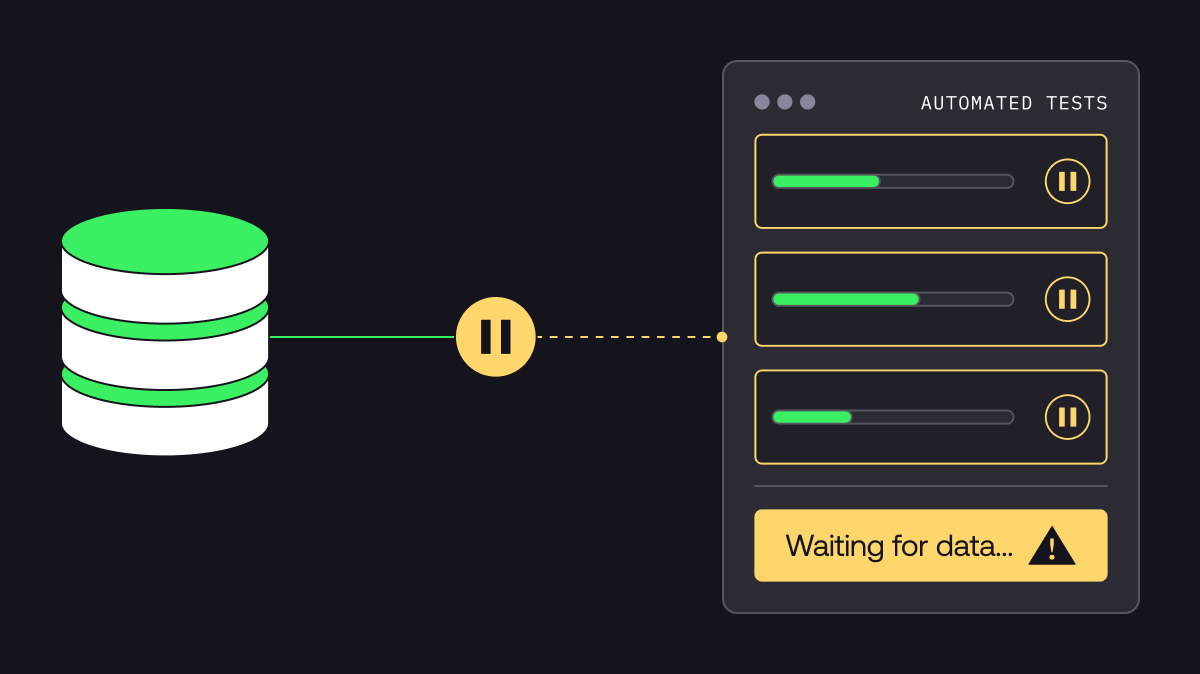
A test can be fully automated and still end up waiting for the data it needs.
The problem might be a customer record that doesn’t meet the test's required conditions, an order that has already been processed, or an account that another test has modified. In other cases, suitable data exists in production, but copying it directly into a test environment can expose personally identifiable information (PII) and other sensitive data.
Teams can make significant progress automating test execution while still relying on manual processes to provision the underlying data. As test suites grow and more tests run in parallel, that dependency becomes harder to manage, particularly when undertaking complex cross-system testing.
Here are seven common test data challenges that can block or slow down test automation.
1. Test data isn’t available when automated tests need to run
An automated test can run only when the data required for that scenario is available in the right state.
In practice, that isn’t always the case. A scheduled test might require a particular type of customer, account, product, or transaction, and finding a suitable record can become a manual task for the testing team.
At a small scale, this can be manageable. As the volume and frequency of automated testing increase, however, repeatedly sourcing and preparing suitable records can slow down a process designed to run with minimal intervention.
For teams running tests continuously or as part of CI/CD pipelines, waiting for test data can become a major blocker.
2. Hardcoded test data makes automated tests difficult to reuse
Many automated tests begin with known data values embedded directly in the test script. It can be a practical way to get a test working, particularly when the test suite is still relatively small.
Problems emerge when those tests need to run repeatedly or in parallel.
For example, a script might depend on a particular customer ID or order number. If another test changes that record first, the original test may no longer find the state it expects. Parallel execution makes this particularly difficult because several tests can end up competing for the same records.
As test suites scale, reusable tests need a more reliable way to access suitable data without depending on a small pool of fixed values.
3. Test data has already been consumed or changed by another test
Automated tests frequently change the data they use.
An order may move into a new status after it has been submitted, an account may be updated during a workflow, or a customer may no longer meet the conditions required to run the same scenario again.
This can make repeated test execution surprisingly difficult. The record still exists, but its state has changed, and restoring it manually before every run undermines much of the efficiency automation provides.
The challenge becomes greater when multiple tests use the same environment. Teams need a reliable way to provide data in the state each test expects without constantly resetting shared records or investigating failures caused by earlier test runs.
4. Production data creates privacy and compliance risks in test environments
Production systems contain exactly the kind of complexity that makes data valuable for testing. They also contain sensitive information that organisations need to protect.
Customer details, employee information, financial records, and other confidential data may be subject to internal security policies and regulatory requirements. Copying production data directly into development or test environments can therefore create unnecessary exposure.
Masking or anonymising sensitive information is part of the answer, but the resulting data still needs to work for testing.
If transformations alter important characteristics or break relationships between records, teams can end up with privacy-safe data that no longer represents the scenarios they need to test. Effective test data therefore has to protect sensitive information while retaining the structure, relationships, and statistical characteristics that matter to the application.
5. Test data doesn’t cover enough edge cases and negative scenarios
Test coverage depends on more than having enough data. The dataset also needs to contain the conditions the application is expected to handle.
Common business scenarios are usually straightforward to find. More unusual cases can be much harder. A team might need to test a rejected payment, a missing attribute, an order that crosses a particular threshold, or a value sitting at the edge of an allowed range.
If those conditions aren’t represented in the available data, they may receive less testing simply because creating the necessary records takes additional work.
This becomes particularly important as testing becomes more automated. Running a large number of tests doesn’t necessarily provide broad coverage if those tests repeatedly exercise similar data and the same predictable scenarios.
Being able to create data for specific conditions gives teams much more control over what their automated tests actually cover.
6. Test data relationships break within connected datasets
Enterprise tests rarely depend on a single isolated record. The underlying data usually includes relationships and dependencies that must remain intact for the test to work.
Consider an Order-to-Cash process. An order needs to belong to a valid customer, its line items need to reference the correct products and pricing, and subsequent delivery and invoice records need to relate to the original transaction.
Individually, each record could look perfectly realistic. But if the relationships between them are broken, for example, an order references a customer or product that doesn’t exist in the test dataset, the data can no longer support the business process being tested.
This becomes particularly challenging when test data spans multiple tables, schemas, or connected databases. Preserving referential integrity is critical: useful test data needs to preserve the relationships and dependencies between records, not simply generate realistic values in individual fields.
7. Test data doesn’t stay consistent across SAP and non-SAP systems
Many enterprise business processes cross several applications, which creates an additional test data challenge.
A process might begin in a CRM, move into SAP, interact with another internal application, and eventually trigger a transaction elsewhere. The customer represented in the CRM needs to correspond with the right customer in SAP, while product information, pricing, account details, and other business attributes may also need to remain consistent as the process moves between applications.
This creates a different challenge from maintaining relationships within a dataset: teams need to ensure that the same business process remains coherent across separate systems with different data models and identifiers.
When that cross-system consistency breaks, an automated test can fail even when each application and its underlying data are valid in isolation. For teams testing complex SAP processes alongside non-SAP applications, maintaining those relationships can become one of the more difficult parts of preparing reliable test environments.
Why does test data become a bottleneck for test automation?
Across these seven challenges, there is a common problem: test data preparation often remains separate from the automated testing workflow.
Teams may have highly automated test execution but still depend on people to source suitable records, restore data to the required state, apply privacy controls, or create scenarios that aren’t already available.
That approach becomes increasingly difficult as automated testing scales. Faster and more frequent test execution creates more demand for data, while parallel testing increases the need for tests to have independent access to the records they require.
Bringing data preparation into the automated workflow allows the data to be provisioned for the test scenario when it is needed. Depending on the use case, that can involve generating data, transforming existing datasets, applying privacy controls, or preparing connected data across multiple systems.
How does Synthesized address test data blockers?
Synthesized uses AI-powered generation, masking, subsetting and provisioning to deliver compliant, production-realistic test data on demand. It preserves the relationships, business rules and cross-system consistency required for reliable testing across SAP and non-SAP environments.
For automated testing, this changes the role of test data from a prerequisite that has to be dealt with separately into something that can become part of the workflow itself.
How do Synthesized and UiPath automate test data provisioning?
The Synthesized integration with UiPath Test Cloud brings test data provisioning directly into the automated testing workflow. Teams can generate and provision the data they need from within their UiPath Test Cloud workflow, without switching between platforms or managing test data preparation separately.
That helps testing teams:
- Provision test data without context switching. Generate and provision the data required for a test from within the UiPath Test Cloud workflow.
- Reduce manual data preparation. Spend less time finding, preparing, and resetting suitable records before automated tests can run.
- Support repeatable and parallel testing. Reduce reliance on hardcoded or shared records that can be changed or consumed by other tests.
- Protect sensitive data. Apply privacy controls while providing production-realistic data for testing.
- Keep complex scenarios connected. Preserve the relationships and business context tests depend on across SAP and non-SAP systems.
Together, UiPath Test Cloud and Synthesized bring test execution and test data provisioning into a more connected workflow, so the data can keep pace with the automation using it. See how Synthesized and UiPath automate test data provisioning.
Better Together: Automate the Tests. Automate the Data.