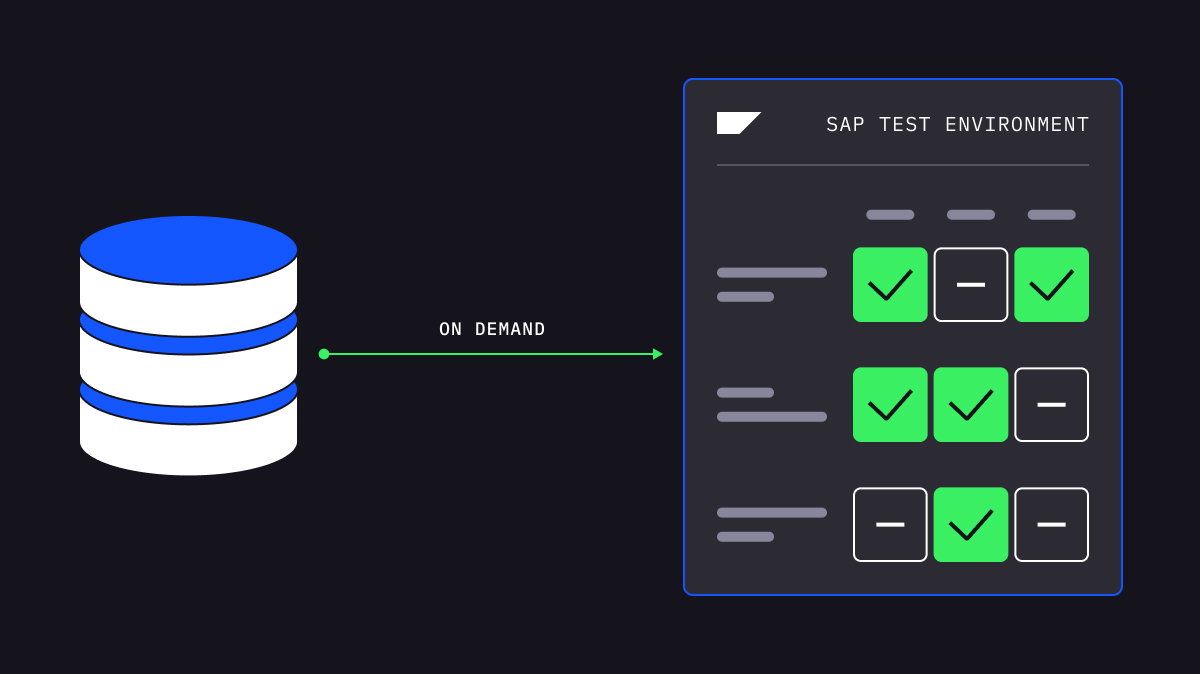
TL;DR
- Referential integrity in SAP test data isn't just a database concern. It determines whether the business scenario being tested still makes sense.
- Copying, masking, subsetting, or generating data without preserving relationships can create incomplete or inconsistent transactions.
- The result can be false test failures, missed defects, unstable automation, and hours spent diagnosing data rather than code.
- The problem becomes harder across custom Z-tables and business processes spanning multiple SAP modules and non-SAP applications.
- Modern SAP TDM needs to preserve those relationships throughout the test data lifecycle
The Hidden Cost of Broken Referential Integrity in SAP Testing
A failed SAP test doesn't necessarily mean the application is broken. Sometimes, the test data is.
That distinction can be surprisingly expensive.
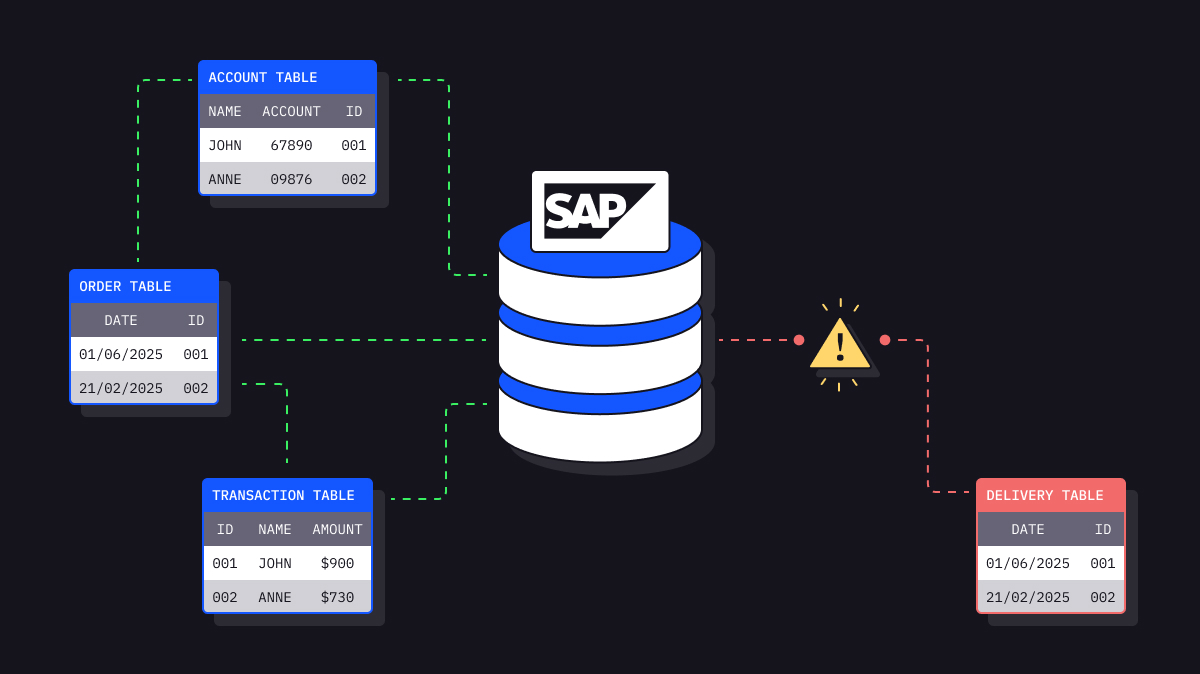
A test might fail because an order has lost its relationship to a customer, an invoice no longer corresponds to the transaction being tested, or a subset contains one part of a business process but not the records it depends on. To the testing team, the immediate result looks much the same as an application defect: something didn't work as expected.
The difference only becomes clear after somebody investigates it.
In complex SAP environments, maintaining referential integrity is therefore more than a technical requirement for moving data between systems. It directly affects how much confidence teams can place in their tests and how much time they spend separating genuine defects from problems introduced by the test data itself.
Referential integrity is easy to lose in complex SAP environments
SAP applications contain enormous numbers of relationships between records. Those relationships extend across standard tables and modules, custom Z-tables, organization-specific configurations, and increasingly the non-SAP applications connected to the wider business process.
Preparing data for non-production environments inevitably interacts with those relationships.
Subsetting selects a smaller portion of production data, but selecting a record without its dependencies can leave a scenario incomplete. Masking protects sensitive information, but inconsistent transformations can break values that need to correspond across tables. Synthetic generation introduces new records that still need to satisfy the relationships and business rules expected by SAP.
Even copying data can create problems when only part of the environment or business process is moved.
This is what makes SAP test data preparation more complicated than producing a collection of valid records. Every operation performed on the data has to consider what those records are connected to and whether those connections remain meaningful afterwards.
False failures have a real cost
One of the most immediate consequences of broken test data is the false failure.
An automated test fails, a defect is created, and somebody begins investigating. A QA engineer reproduces the problem. A developer checks the application logic. An SAP specialist looks at the configuration. Eventually, the team discovers that nothing is wrong with the application at all; the dataset was missing a related record or contained an inconsistent relationship.
The defect can be closed, but the time spent investigating it isn't recovered.
Repeated across a large regression suite, this creates a significant amount of work that rarely appears as a line item in the cost of test data management. Teams see unstable tests, long triage queues, and engineering hours spent investigating failures, without necessarily tracing those problems back to the quality of the underlying data.
It can also erode confidence in automation. When tests fail regularly for environmental or data-related reasons, teams begin to treat failures as noise. Instead of a failed automated test immediately signalling a potential defect, it becomes something that has to be checked before it can be trusted.
At that point, automation may still be running quickly, but the human effort required afterwards starts to undermine the efficiency it was supposed to create.
Broken data can also hide defects
False failures are frustrating because they create work. The opposite problem is potentially more serious.
If test data doesn't accurately represent the relationships and conditions present in production, a test can pass without exercising the scenario it was intended to validate.
Consider a business process where downstream behaviour depends on a particular combination of customer, transaction, material, or financial data. If the test dataset simplifies or breaks those relationships, the test may still execute successfully while missing the condition that would trigger a defect in production.
This is why volume and realism alone aren't enough measures of SAP test data quality. A large dataset filled with production-like values can still provide weak test coverage if the dependencies between those values don't reflect real business scenarios.
Maintaining referential integrity helps ensure that the scenario being validated is structurally representative of the process the business actually runs.
Masking and subsetting need to understand relationships
Two common TDM operations illustrate the problem particularly well.
Subsetting is valuable because teams rarely need a full copy of a large SAP environment for every test. A smaller dataset can reduce infrastructure requirements and make environments quicker to provision. But reducing the volume of data means deciding what belongs in the subset.
Selecting rows independently can produce an apparently sensible dataset while leaving dependent records behind. Effective subsetting therefore needs to follow relationships through the data so the resulting subset contains complete scenarios rather than disconnected fragments.
Masking introduces a similar requirement. Sensitive information needs to be protected in non-production environments, but transformations have to remain consistent wherever related values occur. Privacy can't come at the cost of destroying the relationships the application needs in order to behave correctly.
The objective isn't simply to mask more fields or create smaller datasets. It's to do both while retaining data that still behaves like the original business scenario.
Automation magnifies the problem
In manual testing, an experienced tester can sometimes recognize that a scenario looks wrong and compensate for it. They might choose another record, correct an input, or find a transaction that contains the dependencies they need.
Automated testing assumes those dependencies are already in place.
As regression suites become larger and execute more frequently, inconsistent data gets encountered at machine speed. A problem that might previously have affected a handful of manual tests can cause failures across repeated pipeline runs.
Continuous testing increases the requirement further. If teams want SAP tests to execute as part of CI/CD workflows, the data has to be provisioned repeatably without someone inspecting and repairing the environment before each run.
AI-assisted testing and agentic QA make the same requirement more pronounced. Automated systems can generate and execute more tests, but that additional capacity only produces useful results if the data those tests consume is reliable.
More automation applied to inconsistent data doesn't solve the problem. It allows the problem to occur more frequently.
SAP integrity increasingly extends beyond SAP
Maintaining relationships within SAP is only part of the challenge. Enterprise business processes increasingly cross system boundaries.
A process may involve SAP alongside Salesforce, Workday, Ariba, payment platforms, internal applications, or other services. Data representing the same customer, employee, supplier, order, or transaction can appear in several places.
This means end-to-end testing can fail even when the data inside SAP itself is consistent. If the corresponding record in another application doesn't match the scenario, the business process is still broken from the test's perspective.
Test data management therefore needs to consider integrity across the wider enterprise landscape. The goal is not only to preserve database relationships, but to maintain enough business context for a complete process to be tested consistently wherever that process travels.
Reliable tests start with reliable relationships
Referential integrity can sound like an implementation detail, but its effects are visible much further up the testing process.
When relationships break, tests fail for the wrong reasons, engineers spend time diagnosing data problems, automation becomes noisy, and important production scenarios can go insufficiently tested. In business-critical SAP environments, those aren't minor inconveniences.
Modern SAP TDM needs to protect relationships throughout the entire test data lifecycle. Whether data is copied, masked, subsetted, generated, refreshed, or provisioned, the resulting environment should retain the business logic required by the tests running against it.
That is what turns a collection of realistic records into reliable test data, and reliable test data into greater confidence in the business processes SAP supports.
See how Synthesized preserves business context and referential integrity across SAP test data operations. Book a demo to learn more.