Why do banks struggle with compliant test data management?
Because the data that makes tests realistic is the data regulators protect most, and it is spread across systems that have to agree. Core banking, payments, CRM, SAP and the documents around them each hold part of the same customer, so masking one system at a time breaks end-to-end tests, while copying production into test breaks the rules. DORA's ICT risk standard allows only anonymised, pseudonymised or randomised production data in non-production environments, GDPR treats every test copy of personal data as processing, and PCI DSS keeps live card numbers out of pre-production. Add mainframes and core banking platforms such as Temenos and Avaloq, refreshes that take weeks, and statements and KYC files that sit outside the databases, and many banks end up choosing between slow, safe test data and fast, risky copies.
What makes managing test data risky for financial institutions?
Four things come up again and again:
- Unmasked copies. Production snapshots in UAT, offshore or vendor environments put account numbers, transactions and KYC data under weaker controls than production.
- Forgotten files. Statements, scanned forms, emails and call transcripts copied alongside the databases are often left unmasked.
- Inconsistent masking. A customer masked one way in core banking and another way in the CRM breaks tests, which pushes teams back to real data.
- No evidence. Without a record of what each refresh masked, a bank can't show auditors or its ICT risk function that its test data met the rules.
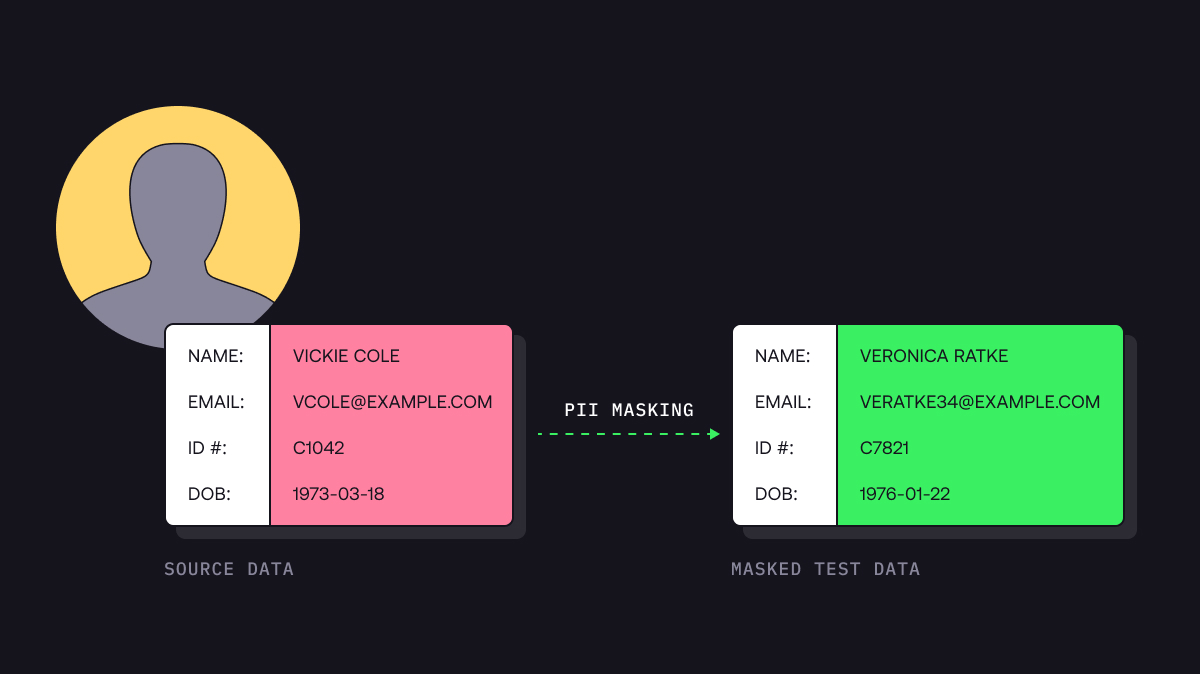
The fix is the same each time: masked or synthetic data, one masking rule per customer across every system and file, and a run record for every refresh.
Start here
Why test data is a regulatory issue for banks
Most regulatory attention goes to production. Test environments, development sandboxes and QA systems often carry the same sensitive data with far less oversight. Account numbers, transaction histories, KYC records and credit decisioning data are regulated wherever they sit, and one unmasked record in a test environment is enough to become a board-level issue.
- DORA: the ICT risk standard (Commission Delegated Regulation (EU) 2024/1774, Art. 16(5)) says non-production environments store only anonymised, pseudonymised or randomised production data, with a narrow exception for approved, time-limited test occasions. See DORA and test data.
- GDPR applies to personal data in every copy of a system, including test and development.
- PCI DSS v4.0.1 requirement 6.5.5 keeps live card numbers out of pre-production environments unless they are part of the cardholder data environment and protected as such. See PCI DSS test data.
- BCBS 239 sets principles for risk data aggregation and reporting; changes to the systems behind those reports need test data realistic enough to validate them.
- UK firms also work to FCA and PRA expectations that don't always mirror EU requirements.
Testing AI agents before they touch live systems
Agents in banking operations read emails and documents, update customer records and move money. They need a realistic world to be tested in: the same customer across core banking, CRM, payments and the documents that arrive with each request, with none of it real. Synthesized builds that world inside your environment and resets it for every run, so agent behaviour can be tested, compared and evidenced before release. See how banks can test AI agents safely, the Test Data Agent and the safe-state layer.
Built for core banking and the systems around it
Core banking data is tightly interrelated, and some fields can't change without breaking the logic that depends on them. In Temenos T24, for example, account and customer records are threaded through structures that downstream modules rely on. Mask a field without understanding that chain and the result isn't a safer test environment, it's a broken one.
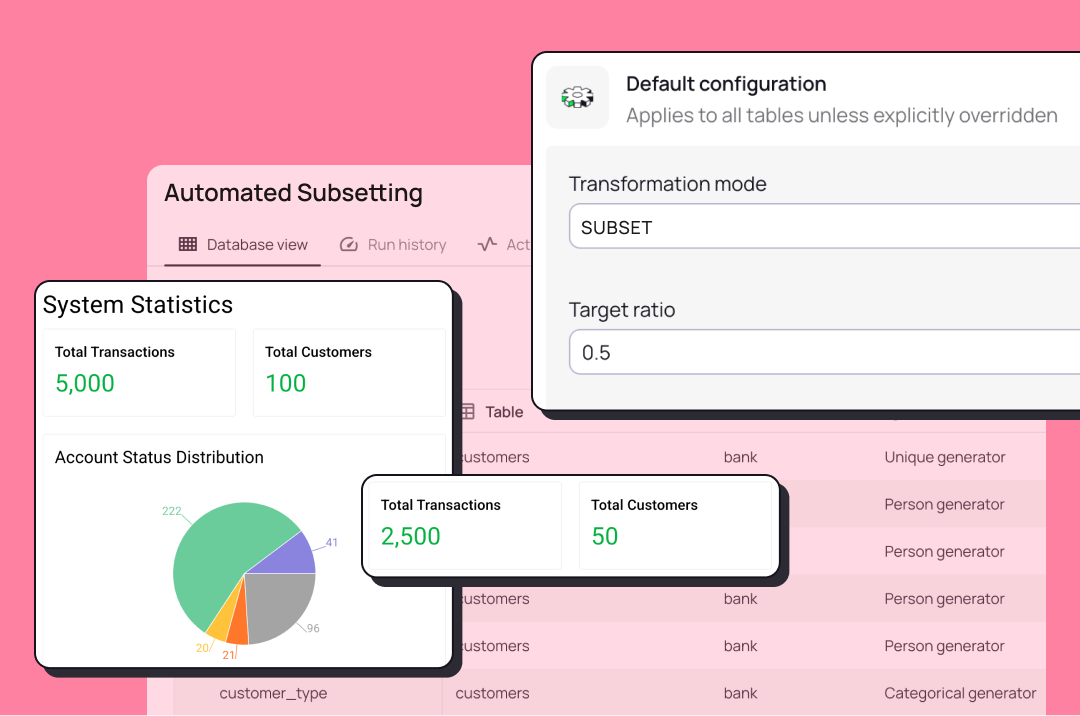
Synthesized keeps referential integrity and business rules intact across core banking, digital channels, CRM and payments, so the same customer, account and transaction line up in every system and end-to-end tests mean something. It also reaches mainframe data in Db2 for z/OS 13+, Db2 for i and VSAM. Read more about Temenos testing, Avaloq testing, SAP test data and Salesforce.
How Synthesized works in a bank
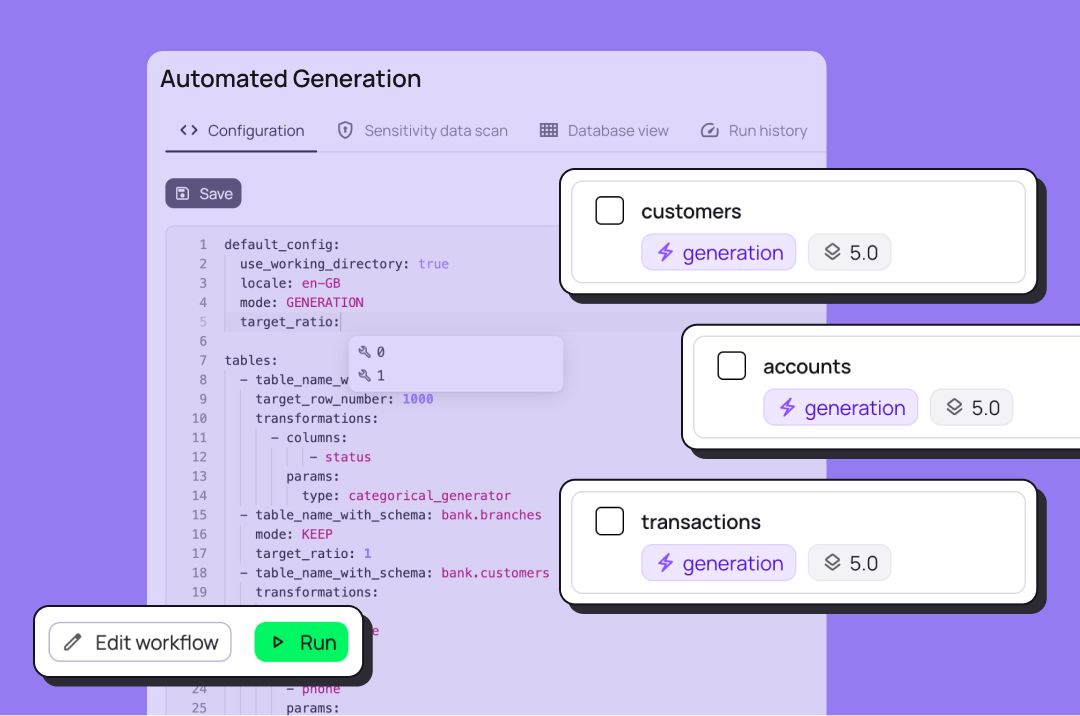
- Production-realistic data: account structures, transaction histories and relationships are preserved, so tests reflect how the systems actually behave.
- Financial-aware masking: account numbers, KYC records and credit decisioning data are treated with the same rigor as names and addresses, not left to generic PII detection.
- Synthetic edge cases: generate fraud patterns and rare conditions that production data never captures.
- Consistency across systems: the same customer and account across core banking, digital channels and payments.
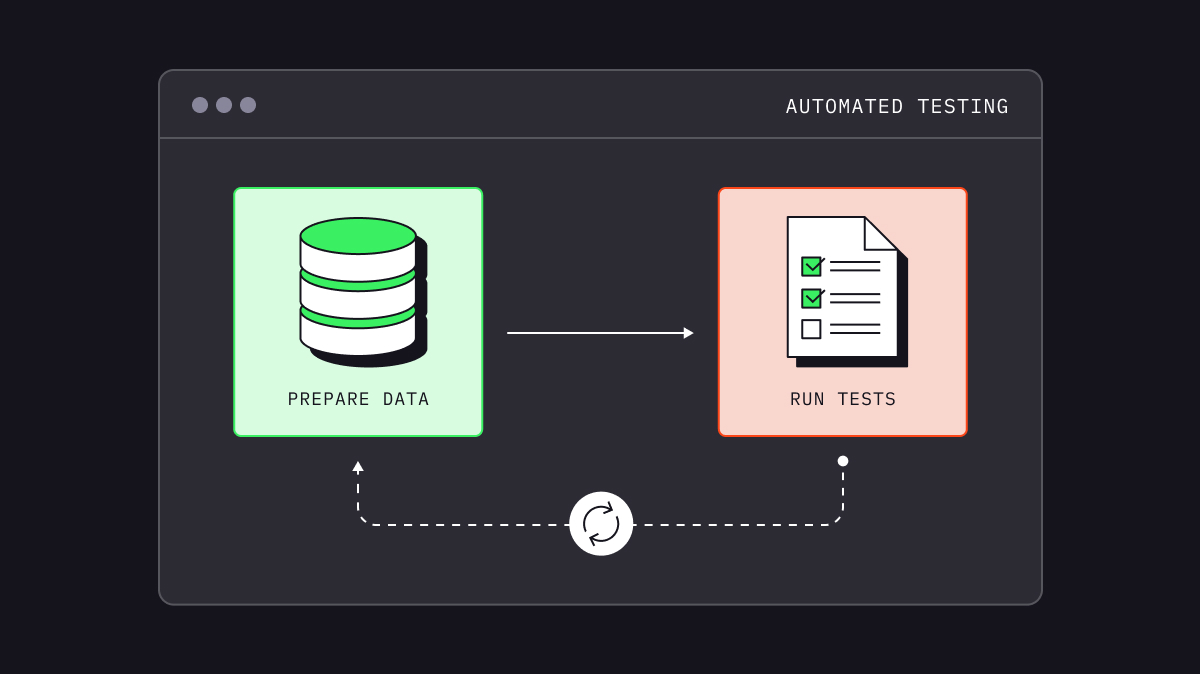
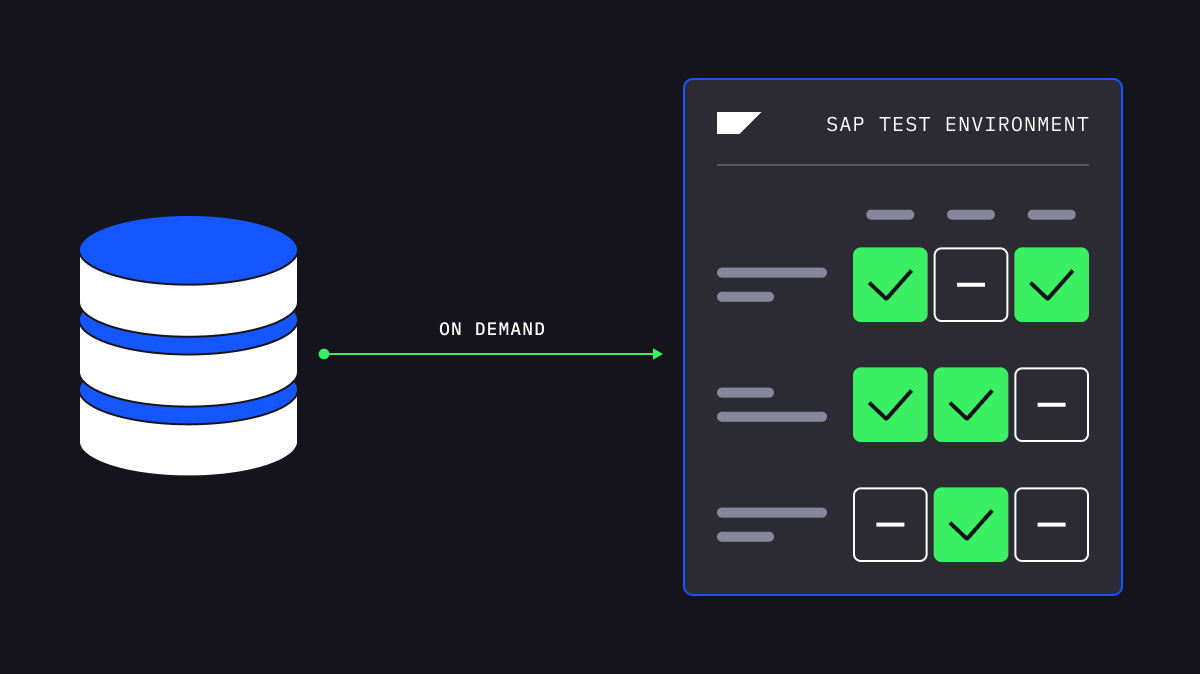
- On demand, in your pipeline: self-service access for distributed teams and CI/CD integration for continuous testing.
Questions banks ask
Does production data have to leave our environment?
No. Synthesized runs inside your own environment, on-premises, including air-gapped, so masking, subsetting and generation happen under your existing security controls.
How does it help with DORA resilience testing?
DORA expects regular testing of ICT systems, from vulnerability scans to scenario-based and end-to-end tests. Synthesized lets teams run that testing on masked or synthetic data, so non-production environments hold only the kinds of data the ICT risk standard allows.
Can we test AI agents with it?
Yes. The Test Data Agent builds linked customers, accounts, transactions and documents for each agent scenario inside your environment, so agents are validated before they act on live systems.
Can we test fraud and credit risk models?
Yes. AI-driven fraud detection and credit risk models need realistic, governed data before they can be trusted in production. Synthetic data covers the rare and adversarial cases production doesn't contain.
Which banking platforms does it support?
Synthesized works with core banking platforms such as Temenos and Avaloq, with SAP and Salesforce, with mainframe Db2 and VSAM, and with the relational databases behind them, keeping data consistent across all of them.
For a fuller view, read Test data management for financial services: what banks and insurers need to know, compare the best test data management tools for banks, or book a demo.