Automating an SAP test doesn't necessarily mean the entire testing process is automated.
A UiPath test may be ready to run, but it still needs suitable customer, material, and other supporting records in the right state. Preparing those records manually creates a dependency outside the automated workflow, particularly when tests run frequently or in parallel.
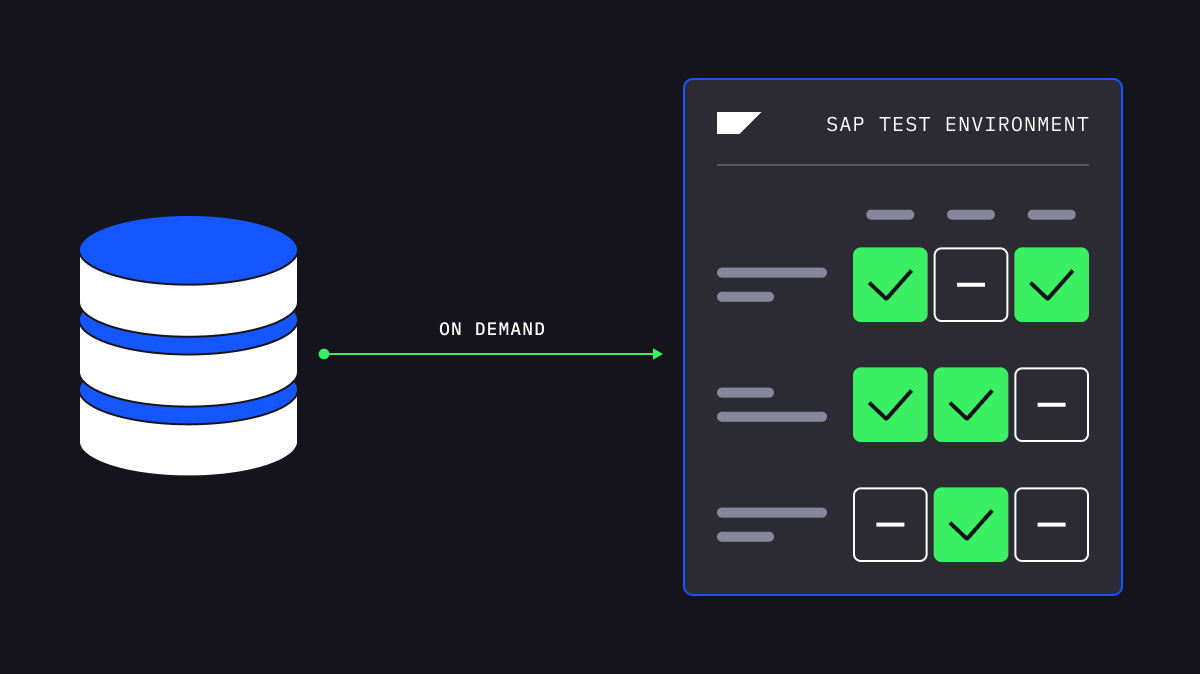
On-demand test data provisioning addresses this by making scenario-specific data available as part of the testing process.
What is on-demand test data provisioning?
On-demand test data provisioning means preparing and providing the data required for a particular test when it is needed, rather than depending entirely on shared datasets or scheduled environment refreshes.
The important part is the test scenario. A large volume of realistic records is not necessarily useful if none represent the conditions being tested. An automated test might need a customer with a particular account status, a material with specific characteristics, or supporting records that let you exercise an exception scenario.
Provisioning can be triggered programmatically as part of the automated workflow:
Test initiated → data requested → scenario-ready data provisioned → test executed
The test no longer depends on a separate preparation process being completed beforehand.
Why is SAP test data difficult to provision on demand?
SAP test data depends heavily on business context. An individual record may be technically valid but unsuitable for the process under test.
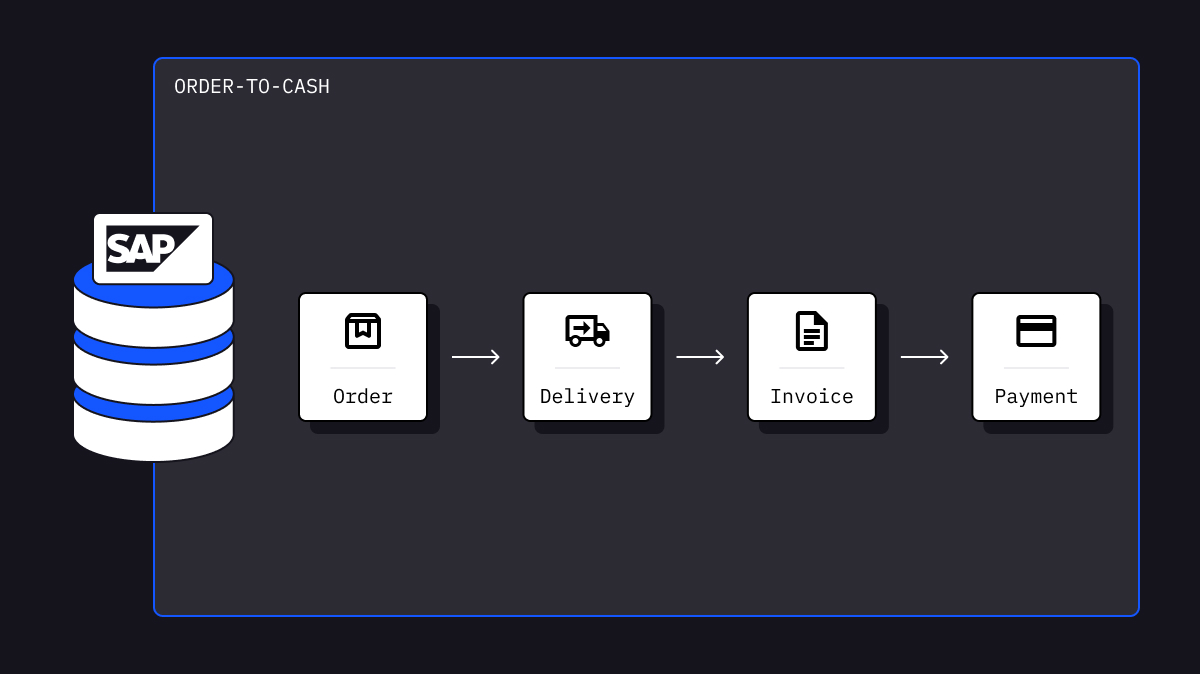
An Order-to-Cash test, for example, may require a customer, material, pricing conditions, and organizational data that are consistent with one another. The automated test can then create and progress a sales order through the relevant business steps.
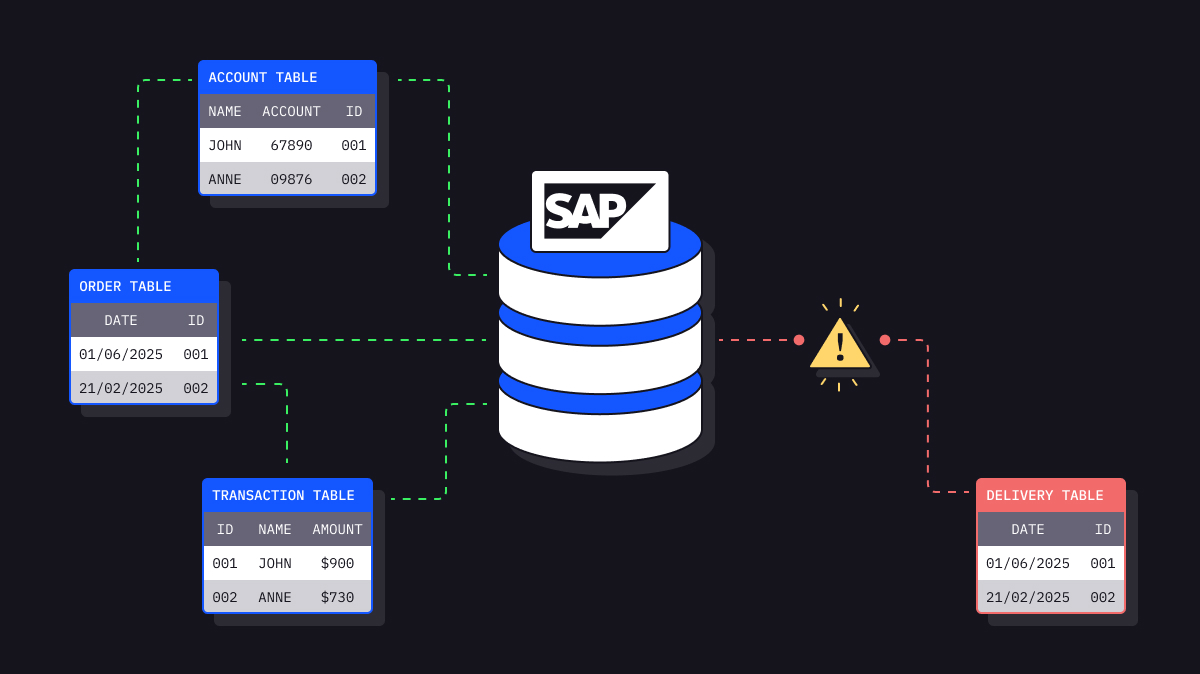
The challenge exponentially increases when a business process extends beyond SAP into connected enterprise applications. Data must remain consistent across the systems involved, including the relationships and business rules the test relies on.
Provisioning SAP test data therefore involves more than copying records. It requires a usable starting state that supports the intended business scenario.
What should an on-demand SAP test data workflow provide?
Effective on-demand provisioning needs to deliver data that is:
- Production-realistic: Representative of the business conditions being tested, using scrambled production-derived data, synthetic data, or a combination.
- Compliant: Protected through appropriate masking, generation, and privacy controls before use in non-production environments.
- Connected: Consistent with the relationships, business rules, and dependencies required by the scenario.
- Scenario-appropriate: Prepared for the particular conditions the automated test needs to exercise.
- Accessible programmatically: Available through APIs or integrations so an automated workflow can initiate provisioning.
These requirements are particularly important in SAP environments, where a test may depend on several related records being available in the correct initial state.
How does on-demand test data provisioning work with UiPath?
UiPath Test Cloud supports automated testing across SAP and connected enterprise applications. The Synthesized integration makes test data provisioning part of that workflow.
In practice, the process follows four steps:
- UiPath initiates the automated test. The test requires a particular business scenario and its supporting data.
- The test invokes a Synthesized data workflow. The request specifies the required data or starting conditions.
- Synthesized provisions the required data. It can generate, mask, subset, or otherwise prepare relevant records while maintaining the necessary relationships and privacy controls.
- UiPath executes the test. The automation uses the prepared data to perform and validate the intended business process.
This lets the testing workflow coordinate data provisioning and test execution, while each platform handles its role.
What does on-demand provisioning look like for an SAP Order-to-Cash test?
Consider a UiPath test designed to validate an Order-to-Cash process, including sales order creation, delivery, billing, and financial posting.
Before the test can begin, it needs an appropriate customer, material, pricing conditions, and other supporting records. These must satisfy the business rules for the scenario, and some may need to exist across connected systems.
Finding suitable records in a shared environment can be difficult, especially when their status or availability changes between test runs.
With on-demand provisioning, Synthesized can prepare the customer, master data, dependencies, and initial process state required for the test. UiPath can then create or advance the order through delivery, billing, and posting, validating the application behavior at each stage.
The distinction matters: Synthesized prepares the conditions needed to run the test; the automation performs the business transactions being tested.
How does on-demand test data support parallel and repeatable testing?
Parallel testing adds an additional requirement: independent test runs need suitable data that another run won't unexpectedly change.
Hardcoded records and shared datasets can create contention when multiple tests update the same customer, order, or transaction state.
On-demand provisioning helps address this by giving each run its own suitable records or an isolated dataset. Tests can then be repeated more reliably, and parallel executions are less likely to interfere with one another.
This is particularly useful for CI/CD pipelines and automated regression suites, where tests may run frequently without someone coordinating the underlying records.
Why scheduled refreshes alone cannot keep pace with continuous test automation
Many testing teams still rely primarily on scheduled environment refreshes. These remain useful for establishing a baseline environment, but they cannot always provide the specific data continuous and parallel tests needed at the point of execution.
Different tests may need particular business conditions, exceptions, or initial states that aren't present in the refreshed environment.
On-demand provisioning complements scheduled refreshes by preparing those scenarios when they're needed, without requiring another full refresh or separate manual preparation cycle.
Automate the tests. Automate the data.
SAP test automation depends on more than executing test steps. It also needs reliable access to the business data that makes those steps possible.
With UiPath handling test execution and Synthesized provisioning compliant, production-realistic, connected data for each scenario, teams can bring data preparation into the same automated workflow.
Better Together: Automate the Tests. Automate the Data.
Learn more about the Synthesized integration with UiPath Test Cloud.