TL;DR
- SAP business processes don't fit neatly inside individual tables or modules, so test data can't be treated as though they do.
- Data can be technically valid within one part of SAP while still being inconsistent with the wider business process being tested.
- Broken relationships between customers, orders, deliveries, invoices, vendors, payments, and other records can undermine end-to-end testing.
- Business-process-aware TDM preserves those relationships across processes such as Order-to-Cash, Procure-to-Pay, and Record-to-Report.
- As SAP becomes more connected to the wider enterprise application landscape, test data also needs to remain consistent across SAP and non-SAP systems.
Why SAP Test Data Needs Business Context
SAP testing has a particular problem with data: a record can be perfectly valid on its own and still be useless for the test you actually need to run.
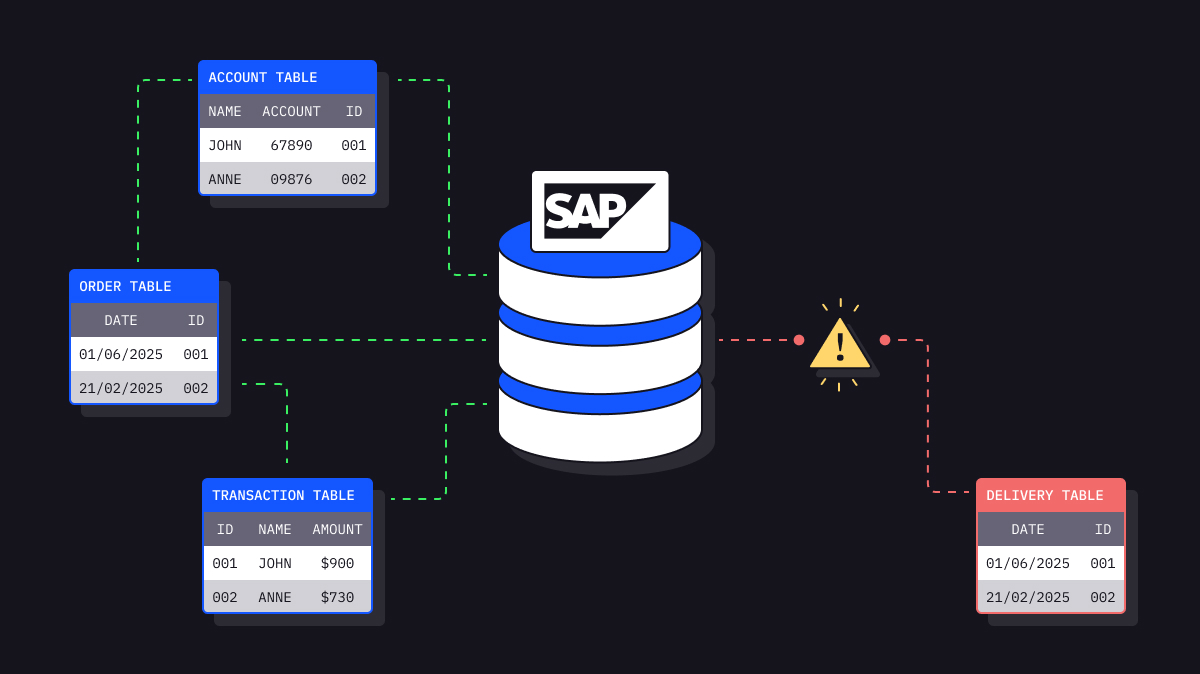
A sales order might exist. The customer record might be present. An invoice might have all the right fields populated. But if those records don't belong to the same transaction, follow the right business rules, or maintain the relationships expected by the process, having each individual piece of data available doesn't create a valid test scenario.
This distinction matters because businesses don't use SAP as a collection of isolated tables. They use it to run processes. Orders become deliveries and invoices. Purchase requisitions become purchase orders and payments. Financial transactions move through systems before appearing in reporting.
Testing those processes requires test data that moves with them.
Traditional approaches to SAP test data management have often focused on the system, table, or module containing the data. As enterprises increase test automation and connect SAP to more of the application landscape, that boundary becomes increasingly limiting. Effective SAP testing needs to preserve the logic of the business process itself.
A business process is more than the data inside one module
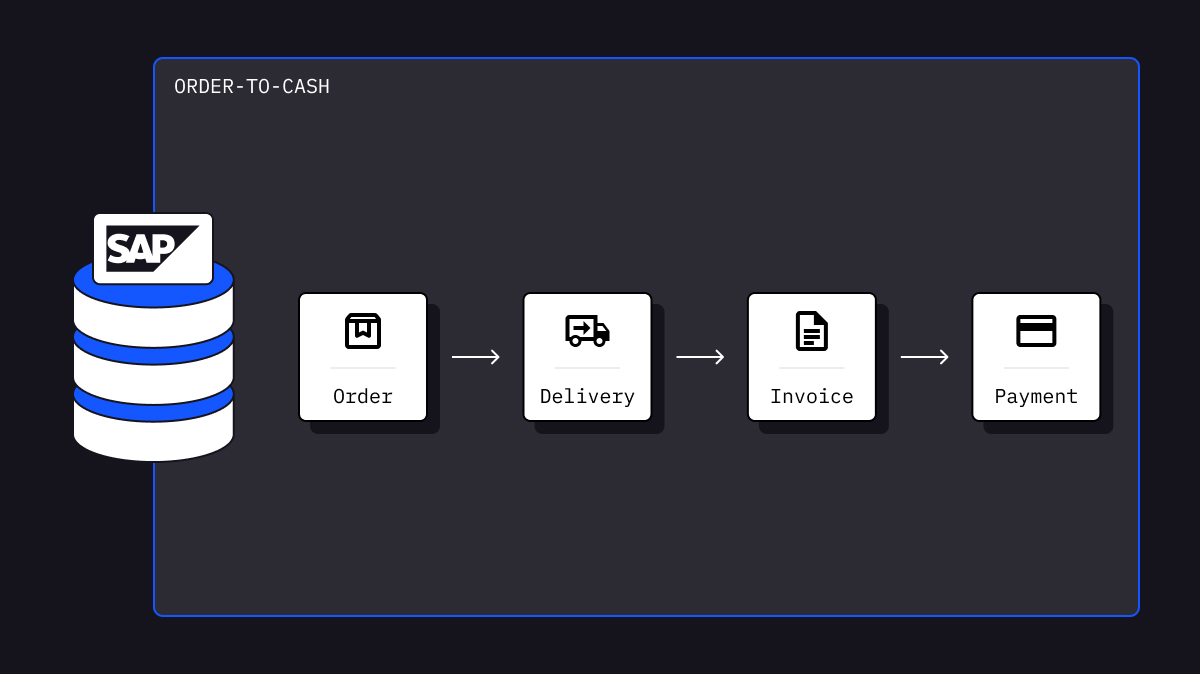
Consider Order-to-Cash. Even a simplified version can involve customer master data, sales orders, inventory, deliveries, billing, payments, and financial postings.
Each stage depends on what happened before it. The sales order has to belong to the right customer. The delivery has to correspond to that order. The invoice needs to reflect the goods or services delivered, while the payment and financial records need to complete the same transaction.
The same principle applies to any other SAP business processes. The test isn't simply whether an individual record exists; it is whether the sequence of records and relationships represents a valid business scenario from beginning to end.
This is one of the reasons SAP test data becomes difficult to manage at scale. Preparing individual tables can produce data that looks realistic when viewed in isolation while failing to preserve the relationships required by the process.
For an end-to-end test, those relationships are the test data.
Technically valid data can still produce a bad test
Test data quality is often discussed in terms of whether data looks like production: realistic values, appropriate distributions, sufficient volume, and representative scenarios. All of those things matter, but SAP adds another important dimension. The data has to make sense together.
If a dataset contains realistic customers, orders, materials, invoices, and payments but the relationships between them have been broken during copying, masking, subsetting, or generation, the resulting test environment may contain plenty of realistic-looking data without representing a realistic business process. That creates problems in both directions.
Tests can fail because the data is inconsistent rather than because the application is defective, creating time-consuming investigation into false failures. More seriously, tests can pass while failing to exercise the relationships and conditions that exist in the real process, allowing defects to escape into production.
The question for SAP TDM therefore can't stop at whether individual records are valid. It also has to consider whether the complete scenario remains valid after the test data has been prepared.
Referential integrity has a business meaning
Referential integrity is often treated as a database concern: one record refers to another, and those references need to remain intact.
In SAP testing, the implications go further. Those technical relationships frequently represent real business dependencies. Breaking them can mean breaking the scenario being tested.
When data is copied or subsetted, the challenge is therefore not simply selecting the right rows. Related records need to move together. When sensitive information is masked, privacy has to be protected without destroying relationships required by downstream processes. When synthetic data is generated, the resulting records need to follow the rules and dependencies SAP expects.
This becomes particularly important for complex environments containing custom Z-tables and organization-specific processes alongside standard SAP structures. The technically correct relationship between records is only part of the picture; the data also needs to represent how that particular organization actually conducts the process.
Business-process-aware TDM approaches the problem from that perspective. Rather than asking only which tables need data, it starts with the scenario that needs to be tested and maintains the relationships required to execute it.
Test automation raises the standard for test data
Manual testers can compensate for imperfect test environments to a surprising degree. They can search for a different customer, adjust an input, find another transaction, or ask someone familiar with the system why a particular scenario isn't working.
Automated tests don't have the same flexibility.
A regression suite designed to validate Order-to-Cash expects the data required by that scenario to be available and internally consistent when the test starts. If the customer exists but the associated order or delivery does not, the automation doesn't care that most of the required data was successfully provisioned. The scenario still cannot run.
As enterprises increase SAP test automation, the repeatability of the underlying data becomes just as important as the repeatability of the test scripts themselves.
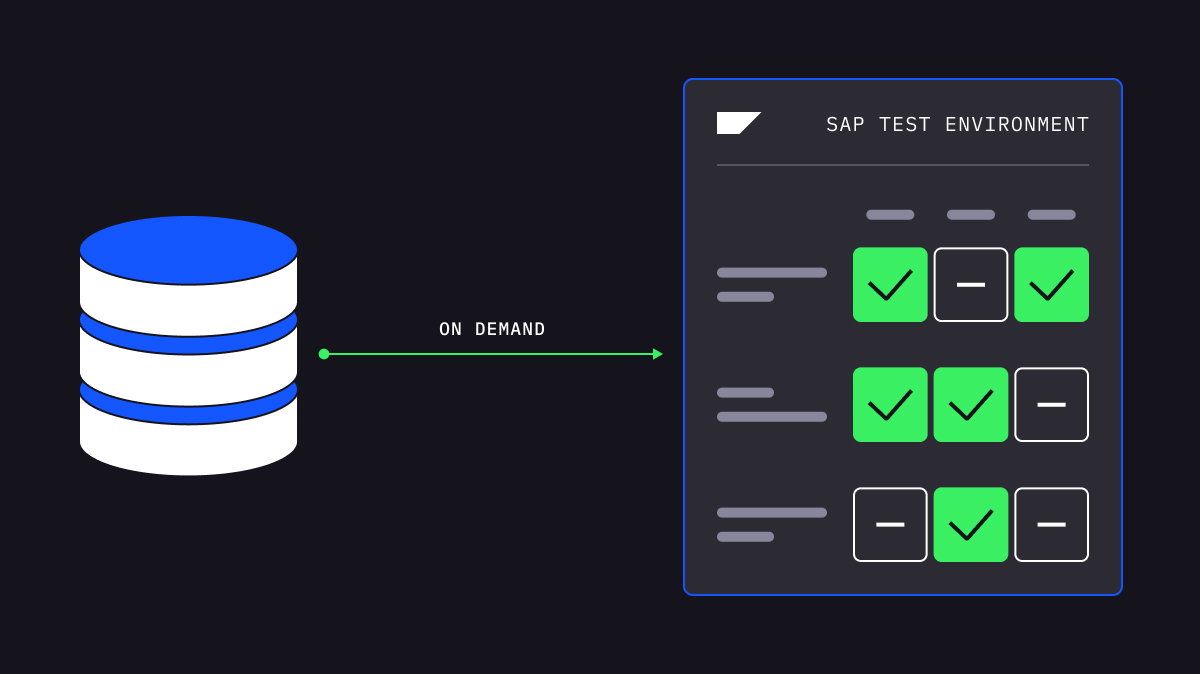
Continuous testing makes this more pronounced. A dataset assembled successfully for one test cycle isn't enough if the next pipeline run requires the same scenario again or needs a variation of it. Test data has to be provisioned reliably and repeatedly while preserving the business logic the automation depends on.
This is why continuous SAP testing requires more than faster environment refreshes. It requires a continuous supply of usable business scenarios.
SAP processes increasingly extend beyond SAP
There is another reason the business-process perspective matters: many enterprise processes no longer begin and end inside SAP.
A customer journey might begin in Salesforce before moving into SAP. Procurement processes can involve platforms such as Ariba. HR workflows may interact with SuccessFactors and other enterprise applications. Custom services, data platforms, payment systems, and SaaS applications can all sit somewhere within a process whose core transactions are handled by SAP.
From the business's perspective, these aren't separate tests. They are one process crossing several technologies.
This creates a wider test data problem. Preparing consistent SAP data is difficult enough, but end-to-end testing also requires related data in the non-SAP systems participating in the same journey.
Managing those environments independently increases the likelihood that each contains valid data while the complete scenario remains impossible to execute. Enterprise TDM increasingly needs to preserve business logic not just across SAP modules, but across the wider application landscape.
From SAP test data to business assurance
The purpose of SAP testing isn't to prove that tables contain valid records. It is to provide confidence that the processes the business relies on will continue to work when something changes.
That could be an S/4HANA migration, a quarterly release, a new integration, a configuration change, or an update to a connected application. Whatever the trigger, the risk ultimately sits with the business process.
Test data needs to reflect that same level of assurance.
Business-process-level test data makes it possible to provision scenarios in which the relationships between records remain intact from beginning to end. It allows automated tests to execute against consistent conditions and helps teams distinguish genuine application failures from problems caused by incomplete or broken data.
For complex SAP environments, that's an important evolution in how TDM is approached. Tables and modules still matter technically, but they shouldn't define the boundary of the test data strategy.
The business process should.
See how Synthesized generates and manages SAP test data at the business-process level across SAP and non-SAP environments. Book a demo to learn more.