TL;DR
- Test data management was built for an era when data could be prepared ahead of a test cycle. Modern software delivery increasingly operates continuously.
- CI/CD, continuous testing, and AI-driven workflows create demand for test data on demand, rather than according to fixed refresh schedules.
- That changes the role of TDM. Test data needs to behave more like infrastructure: continuously available, automated, governed, and accessible when teams and systems need it.
- Point solutions for masking, copying, generation, and provisioning can fragment the test data lifecycle and create new bottlenecks.
- The AI-ready enterprise needs a governed test data layer capable of supplying realistic, compliant data across teams, applications, and automation workflows.
For years, test data management has largely been treated as a process that happens in preparation for testing. A team needs data for a new test cycle, an environment gets refreshed, and production data is copied, masked, subsetted, or manually assembled before testing can begin. For a software delivery model built around defined releases and human-led processes, that approach was often enough. But the software delivery model around it has changed considerably: CI/CD pipelines run continuously, automated regression suites can execute hundreds or thousands of tests without waiting for someone to initiate them, and development teams increasingly expect environments and services to be available on demand. AI agents add another layer of automation, generating code, creating tests, executing them, and acting on the results.
Yet underneath all of that automation, test data is still frequently provisioned as though somebody has several days to prepare it. The next evolution of Test Data Management therefore isn’t simply about making the existing process faster. It requires a change in the role TDM plays: from managing data periodically for testing to providing a continuous layer of infrastructure that testing and development can depend on.
Traditional TDM was designed around a request
Most traditional TDM workflows begin with someone asking for something. A QA team needs a dataset, a developer needs an environment refreshed, a release requires a subset of production, or sensitive data has to be identified and protected before it can be copied downstream.
This model naturally creates queues and dependencies. The issue isn’t always that each individual task is particularly slow; it’s that data availability depends on a chain of activities being completed before testing can continue. As the rest of software delivery becomes more automated, those dependencies become much more visible.
A CI/CD pipeline might automatically build and deploy an application in minutes, but the advantage is limited if the test environment depends on a database refresh scheduled for later in the week. A regression suite can run continuously only when it has continuous access to the scenarios and data it needs. Similarly, an AI agent might generate and execute a new test autonomously, but that autonomy has little value if the next step depends on someone manually preparing the right dataset.
Modern software delivery is therefore changing the question enterprises need to ask. Rather than only asking how test data should be managed, they increasingly need to consider how trusted test data can be made continuously available.
What changes when test data becomes infrastructure
We already expect infrastructure to be available when it’s needed. Developers don’t submit a request every time they need to compute, and automated pipelines aren’t designed around someone manually configuring the services required for each run. Mature engineering platforms abstract those operations behind APIs, automation, policies, and self-service workflows. In practice, that looks like a developer requesting a production-realistic dataset the same way they'd request a compute instance, a self-service call that returns masked, referentially intact data in minutes, governed by policies applied automatically rather than configured by hand each time.
Test data increasingly needs the same characteristics. Data should be provisioned on demand rather than solely according to fixed refresh calendars, while privacy controls need to be built into the process instead of applied as a separate step after production data has already been copied. Teams also need the ability to generate realistic synthetic data for scenarios that are rare, missing, difficult to reproduce, or inappropriate to take directly from production.
The lifecycle itself matters too. Generation, masking, copying, subsetting, time slicing, provisioning, and refresh are often treated as separate TDM activities, even though each contributes to the same objective: getting the right data into the right environment when it is needed.
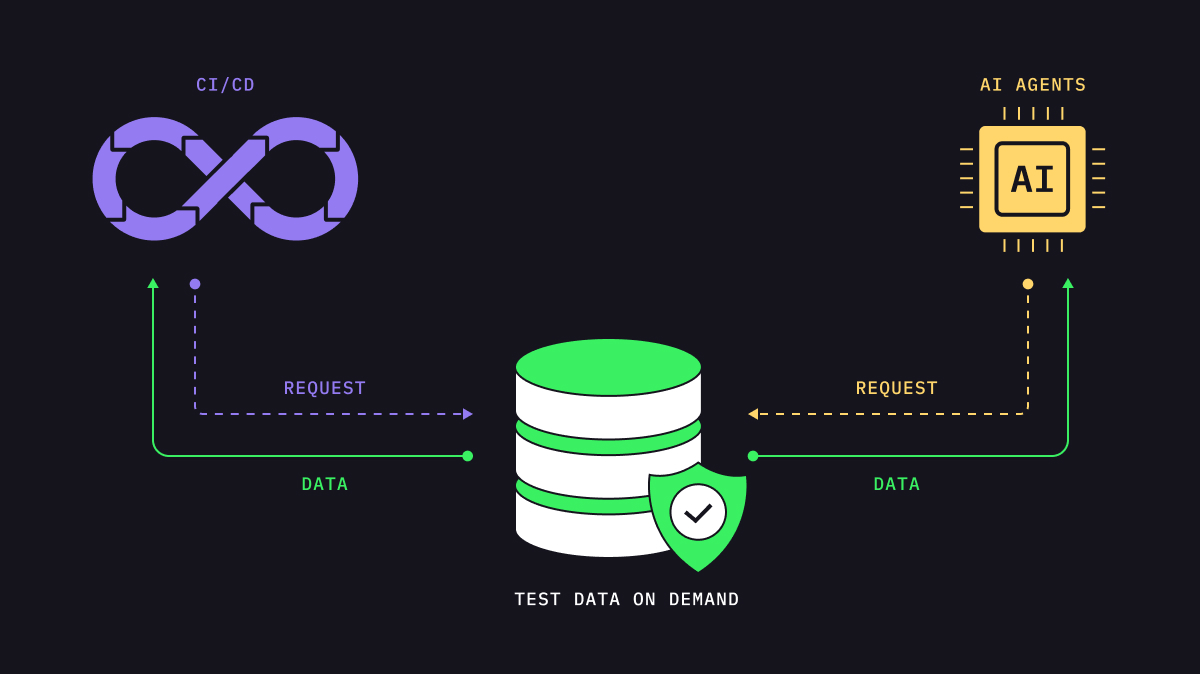
Treating test data as infrastructure means automating that lifecycle so the consumer doesn’t need to coordinate everything happening behind the scenes. A developer, automated test, CI/CD pipeline, or AI agent should be able to access appropriate data without first navigating the operational process required to create it.
In that model, test data stops being something prepared before testing starts and becomes a service that software delivery can continuously consume.
The problem with a fragmented test data lifecycle
This is where fragmented TDM architectures become a bottleneck for continuous delivery. A tool that copies databases, a separate engine that masks sensitive fields, and a third process for synthetic generation may each perform well individually — but when a CI/CD pipeline or AI agent needs all three to happen in sequence, on demand, every handoff between them becomes a point where automation can stall and wait on a person.
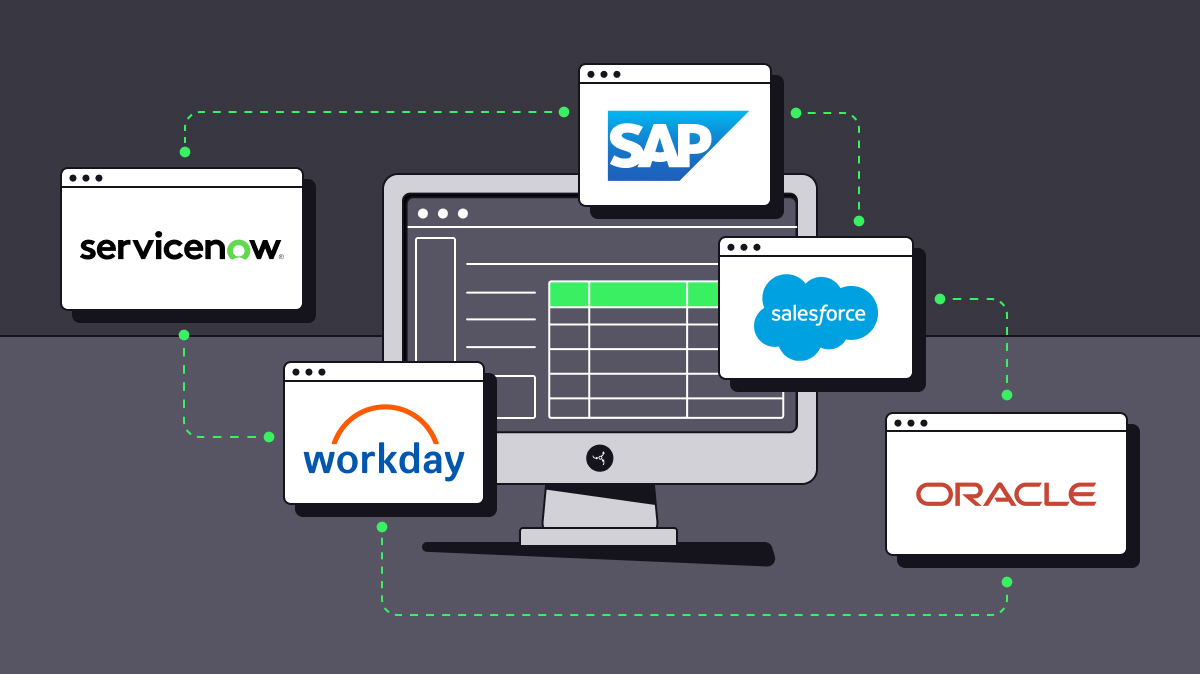
The effect compounds across multi-application business processes, where a transaction moving through SAP, a CRM platform, and a payment service needs consistent, related data at every step. If each application has its own test data process, teams may automate individual operations while the overall test data lifecycle remains fragmented.
This is why test data infrastructure needs to operate across application boundaries, providing a consistent way to generate, protect, provision, and manage data wherever the testing process requires it.
One data layer for an increasingly automated enterprise
An alternative is to manage test data operations as part of one governed layer across the enterprise. That doesn’t mean pretending every application works in the same way. SAP has different requirements from a cloud-native application, just as a mainframe presents different constraints from a modern data platform.
The objective is instead to provide a consistent control plane for how test data is generated, protected, provisioned, and made available across those environments. This allows different teams and systems to consume test data in ways that suit their workflows without creating a separate governance and provisioning model for every technology.
Developers can provision realistic datasets on demand, while CI/CD pipelines receive fresh data as part of an automated run. QA teams can generate specific scenarios and edge cases rather than depending entirely on what happens to exist in production. AI agents can request data programmatically as they execute increasingly autonomous workflows.
Governance can become part of the same layer. Sensitive data discovery, privacy controls, and compliance policies can be applied systematically as data is created and provisioned. For a bank subject to DORA or an insurer navigating PCI DSS and MAS TRM, that means applying those policies consistently across environments, from T24 and SAP S/4HANA to cloud-native applications, rather than each team interpreting compliance requirements independently.
This is the broader shift from Test Data Management to test data infrastructure. The aim isn’t simply to automate more TDM tasks, but to create a continuous and governed supply of data for the teams, pipelines, applications, and agents that depend on it.
AI readiness starts lower in the technology stack
Much of the conversation around becoming an AI-ready enterprise understandably focuses on what organizations can build with AI. Less attention is paid to whether the underlying systems those AI workflows depend on are capable of operating at the same speed.
Test data is one of those dependencies. Organizations can invest in model selection, agent orchestration, and prompt engineering while the data layer those agents depend on for testing and validation is still running on a weekly refresh cycle. An enterprise can be AI-ready at the application layer and still be constrained by the infrastructure underneath it.
AI agents don’t remove the need for realistic data; they potentially increase demand for it. More code can be generated, more tests can be created, and more workflows can execute without human intervention. Each of those activities can create another consumer of test data.
The same principle applies even without AI. As organizations automate more testing and software delivery, manual data preparation becomes increasingly difficult to reconcile with the speed of the rest of the pipeline. Automation can only move as quickly as the systems and resources it depends on, which makes continuous data availability an increasingly important part of the underlying engineering architecture.
The next generation of TDM is continuous
The shift from Test Data Management to test data infrastructure doesn’t mean the fundamentals of TDM disappear. Enterprises still need to generate data, protect sensitive information, copy environments, create subsets, preserve referential integrity, control access, and meet compliance requirements.
What changes is how those capabilities are delivered. Instead of operating as separate activities performed in preparation for testing, they become automated services that can be accessed continuously through a unified platform.
Software delivery is already moving in this direction. Testing is becoming more continuous, development workflows are increasingly automated, and AI is reducing the amount of manual coordination required between stages of the lifecycle. The data supporting those processes needs to make the same transition.
For the AI-ready enterprise, that means moving beyond managing test data as a periodic operational task and building a data layer that is available whenever the business, its developers, its testing pipelines, or its AI systems need it.
Want to see what continuous test data infrastructure looks like in practice? Book a demo with Synthesized and discover how one platform can provide trusted, production-realistic test data across your enterprise.