
TL;DR
- Agentic AI is compressing the entire software development lifecycle, not just automating individual tasks within it
- When agents write code, generate tests, and execute them without waiting for a human, the bottleneck shifts to whatever isn't automated yet
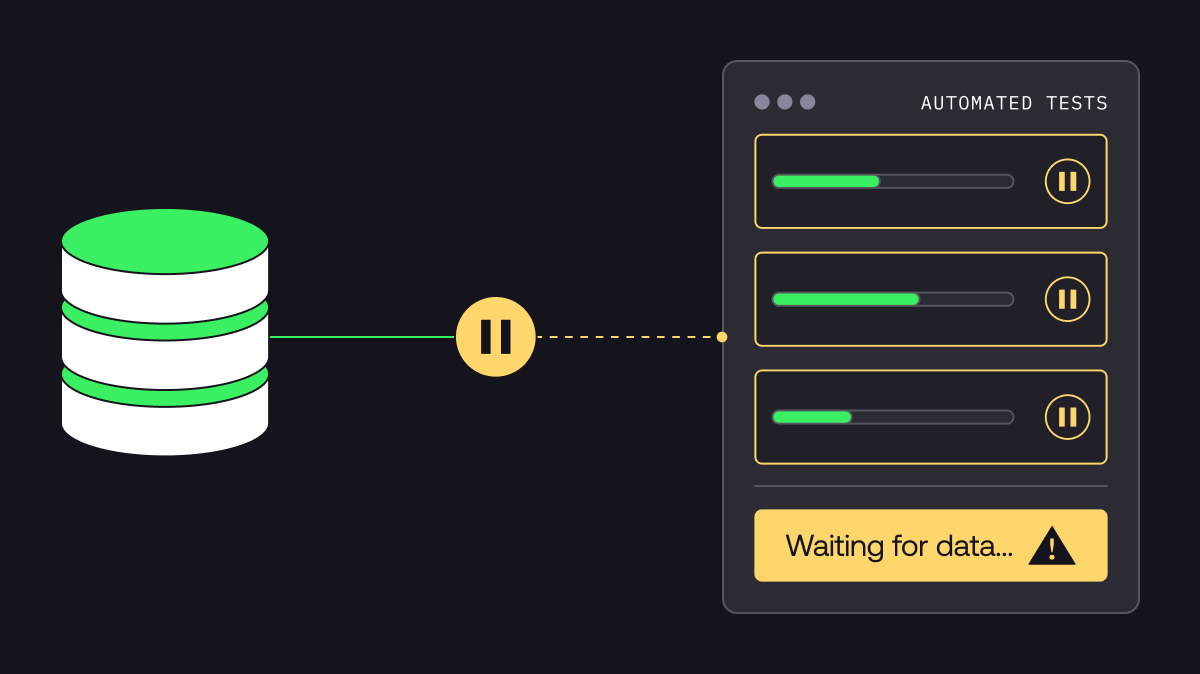
- For most organizations, that bottleneck is test data
- Data layers built for a slower, human-paced development process weren't designed for agents that never stop asking for the next dataset
- The teams adapting fastest treat test data as infrastructure that runs continuously, not a task someone prepares in advance
It wasn't long ago that AI in software development meant assistance and little more. A suggested function here, an answered API question there. Useful, but clearly bounded, a human was still in the driver's seat, still the one deciding what actually got accepted.
Things have moved well past that. Agents write code, run tests, look at the results, and decide what happens next without a human in the loop at every step. The lifecycle isn't shrinking because individual tasks got quicker, it's shrinking because the waiting in between them, writing to testing, testing to shipping, is going away.
That compression is exposing a problem that used to be tolerable. It isn't anymore.
Why test data becomes the bottleneck in agentic development
When a human developer writes code, there's a natural pause before testing starts. Someone requests an environment. Someone prepares data. That pause used to be invisible, just part of how software got built, absorbed into the rhythm of a sprint.
Agentic development removes that rhythm. An agent that writes code and immediately wants to test it doesn't pause the way a human does. It doesn't submit a ticket and move on to something else while it waits. It expects the next thing it needs, in this case, data to test against, to already be there.
This is where most pipelines run into trouble. Not because the agent writing code is unreliable, and not because the testing framework can't keep up, but because the data feeding both of them still moves at a human's pace. A weekly refresh. A masking rule maintained by hand. A production copy that eats half a specialist's day to prepare.
The bottleneck hasn't disappeared. It's just moved to whatever wasn't built to keep pace, and for most organizations right now, that's test data.
And once a bottleneck moves somewhere, it's worth asking whether you've been thinking about that thing correctly at all.
Why agentic development depends on production-realistic test data
It would be easy to treat this as a QA issue and leave it there, but that misses the scale of what's changing. Agentic development now runs through every stage of the lifecycle, not just testing at the end. Agents generate code, refactor systems, and validate changes across environments before any human reviews the work. All of it depends on data realistic enough to reflect actual conditions.
An agent refactoring a payment flow needs real transaction data to know nothing broke. An agent building a feature needs real usage patterns to test against, not a simplified dataset that happened to be available.
Treating data as a testing concern rather than a development concern is part of why so many organizations are further along on agentic coding than they are on agentic testing. The coding side has had enormous investment. The data layer underneath the whole pipeline has had comparatively little.
What test data infrastructure for agentic development requires
The organizations building genuinely fast agentic development pipelines have stopped treating data preparation as a step that happens before development starts. They've made it part of the platform itself.
That means:
- Data available through an API on demand, not requested through a ticket
- Compliance and masking applied automatically at the point data is generated, not as a separate task someone remembers to do
- Synthetic generation for edge cases and unusual conditions that agents need but that real production data doesn't reliably contain
- All of this running continuously, at whatever pace the agents on top of it require, not on a weekly human-prep schedule
This is a different mental model from how most data platforms were designed. Legacy tooling was built to serve periodic, human-initiated requests. What agentic development needs is closer to infrastructure: always on, self-service, and fast enough that the agent consuming it never notices it was there.
How continuous test data infrastructure removes the bottleneck
The organizations that solve this aren't necessarily the ones with the most sophisticated agents. They're the ones that stopped treating test data as a periodic chore owned by one team and started treating it as infrastructure, generated synthetically, provisioned programmatically, and governed by policy rather than by whoever happens to be free that week.
That's a bigger shift than it sounds like. It moves test data management from a support function that trails behind development to a service that development (human or agentic) can actually depend on. Until that shift happens, the bottleneck will keep finding test data, no matter how fast everything else gets.
Want to see what a test data layer built for agentic development actually looks like? Book a demo and find out how Synthesized keeps pace with development pipelines that no longer wait for anyone.