.png)
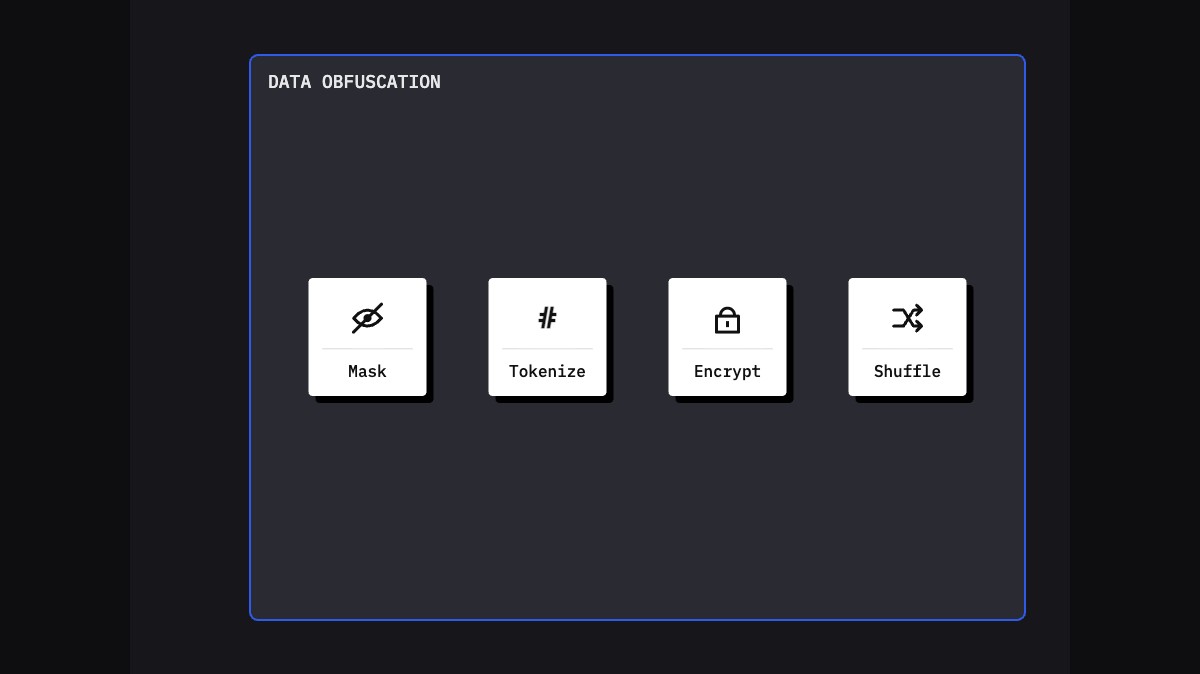
Data obfuscation is the umbrella term for techniques that make sensitive data unreadable or meaningless to people and systems that should not see it, while keeping the data usable for a defined purpose. Masking, encryption, tokenization, redaction and synthetic substitution are all forms of data obfuscation. They differ mainly in whether the original value can be recovered, by whom, and whether the result still behaves like real data.
What data obfuscation covers
The term is used loosely, so it helps to define each technique by two questions:
- Is it reversible? Encryption and vault-based tokenization can return the original value to an authorized system. Static masking, redaction and synthetic data are designed not to.
- Does it keep the data usable? Ciphertext is useless to an application that expects a valid email address or IBAN. Format-preserving masking and synthetic values keep the shape of the data, so software and tests still work.
Choosing a technique is mostly a matter of answering those two questions for each data flow: production access, analytics, test environments, vendor sharing and AI workloads. There is rarely one answer for the whole organization.
Obfuscation vs masking vs encryption vs tokenization
Data masking
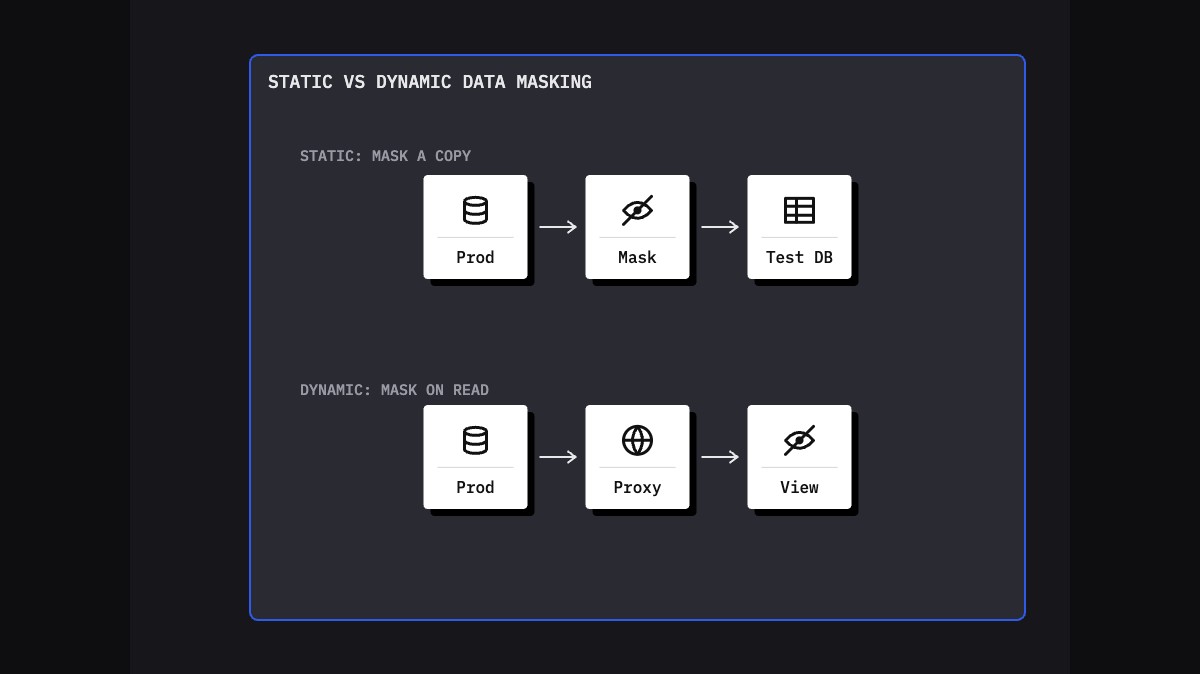
Masking replaces real values with realistic but fictitious ones: a different name, a card number in a valid format that is not a live card, a shifted date. Static masking changes the stored values in a copy of the data and is designed to be irreversible. Dynamic masking hides values in query results for some users while the stored data stays unchanged. For non-production use, static masking is the usual choice because the data itself leaves production. Our data masking guide covers the individual masking techniques in more depth.
Encryption
Encryption transforms data with a key so that only key holders can read it. It protects data at rest and in transit and is reversible by design. Encrypted personal data is still personal data for anyone who holds or can obtain the key. An application under test needs the plaintext, so encryption alone does not make production data safe to use in test environments.
Tokenization
Tokenization swaps a sensitive value for a surrogate token and keeps the mapping in a secured vault. Payment systems use it so that most components handle tokens rather than card numbers. Tokenization does not remove the need to protect the tokenization system itself, and an environment that can retrieve the original card number stays in scope for PCI DSS. Random tokens also carry no business meaning, which limits their use for testing logic that depends on realistic values.
Other obfuscation techniques
- Redaction: removes a value entirely, common in documents and disclosure responses.
- Shuffling (scrambling): moves real values between records within a column, keeping distributions and totals but breaking the link to the person.
- Hashing: one-way, but unsalted hashes of low-variety values such as phone numbers or dates of birth can be reversed by brute force.
- Noise: perturbs numbers and dates within a range, so aggregates stay close while individual values change.
- Nulling and truncation: blank a field or keep only part of it, such as the last four digits of a card number.
- Synthetic substitution: generates new values or whole records with no real person behind them.
The four main approaches at a glance
- Static masking: irreversible, keeps formats, suited to development and test copies.
- Encryption: reversible with the key, changes formats unless format-preserving encryption is used, suited to storage and transport.
- Tokenization: reversible through the vault, can keep formats, suited to payment and other production data flows.
- Synthetic data: no original to recover, keeps formats and statistical shape, suited to new features, edge cases and external sharing.
When to use which
- Production users who need partial visibility, such as support agents: dynamic masking plus role-based access control.
- Data at rest and in transit: encryption, regardless of what other controls are in place.
- Payment card data in production flows: tokenization, to reduce the number of systems that see the full card number.
- Development, QA, UAT and performance environments: static masking of a production copy, often combined with subsetting to reduce volume.
- Data that does not exist yet, or must not trace back to anyone: synthetic generation.
- Documents and free text going to vendors or AI tools: detection plus replacement or redaction in the file itself.
Obfuscating data for non-production use
Non-production environments are where obfuscation choices matter most. Developers, testers, offshore partners and now AI agents need data that behaves like production, and regulators expect personal data there to be protected. Several rules address this directly:
- GDPR requires data minimization (Article 5(1)(c)) and names pseudonymization as a measure under Articles 25 and 32.
- PCI DSS v4.0.1 Requirement 6.5.5 says live card numbers are not used in pre-production environments unless those environments are part of the cardholder data environment and protected accordingly. See PCI DSS test data.
- DORA: for EU financial entities, Commission Delegated Regulation (EU) 2024/1774, Article 16(5), requires non-production environments to store only anonymized, pseudonymized or randomized production data, with a narrow, approved exception in Article 16(6). See DORA test data.
Good non-production obfuscation has six properties:
- Irreversible in the target. No key, vault or mapping table is reachable from the test environment.
- Format-valid. Tax IDs, IBANs and postal codes still pass application validation.
- Consistent. The same customer gets the same replacement in every table, database and file, so integrations and end-to-end tests work.
- Selective. Business codes such as currency, country and company code are kept, because masking them breaks logic without protecting anyone.
- Repeatable. Runs from a versioned policy in the delivery pipeline, with a record of what was treated.
- Complete. Covers free-text columns, attachments and documents, not only structured fields.
Common data obfuscation mistakes
Most failures come from gaps in coverage and consistency rather than from weak algorithms:
- Treating only the obvious columns. Names and emails get masked, while notes fields, attachments, audit tables and integration logs keep the originals.
- Masking each system separately with random values. The same customer gets different replacements in CRM and ERP, and every cross-system test breaks.
- Keeping the key next to the data. A mapping table or encryption key stored in the same environment turns obfuscation back into plain access.
- Hashing low-variety identifiers without a secret. Phone numbers, dates of birth and national IDs can be recovered by hashing every possible value.
- Assuming obfuscated means anonymous. If the data can be reversed or linked back to a person, GDPR still treats it as personal data.
How Synthesized helps
Synthesized obfuscates data for test and development environments. Data masking detects sensitive fields and replaces them with realistic, format-valid values, using one replacement per original value across connected systems so joins and tests keep working. It integrates through an API, a CLI or YAML-based configuration, so masking can run inside the pipeline. Card numbers are replaced with values that keep the format but are not live card numbers. For SAP, SAP data masking covers standard and custom Z-tables while keeping country, currency and company codes intact. Documents, emails and transcripts follow the same policy through unstructured data masking.
FAQ
Is data obfuscation the same as data masking?
Masking is one type of obfuscation. Obfuscation is the broader term for any technique that hides sensitive values, including encryption, tokenization, redaction, hashing, shuffling and synthetic substitution. Masking specifically replaces values with realistic fictitious ones, usually irreversibly when done statically, which makes it the most common choice for test and development copies of production data.
Is encrypted data anonymized?
No. Encrypted data is obfuscated but not anonymized, because anyone with the key can recover the original values. Under GDPR, encrypted personal data remains personal data, and Article 32 lists encryption as a security measure rather than a way out of scope. Encryption protects data at rest and in transit, but tests cannot use it without decrypting it.
What is the difference between tokenization and masking?
Tokenization replaces a value with a token and keeps a secured mapping so authorized systems can recover the original. Masking replaces the value with a realistic substitute and, in static masking, keeps no way back. Tokenization suits production flows such as card payments; masking suits test environments, where nobody should be able to reverse the data.
Which obfuscation technique is best for test data?
Static masking combined with synthetic generation usually works best. Masking a production copy keeps real-world variety and volumes, and consistent, format-preserving replacement keeps applications and integrations working. Synthetic data fills the gaps, such as new features or edge cases that production does not contain. Avoid relying on encryption or tokenization alone, because tests would need the keys.