TL;DR
- Training AI models on real data creates direct compliance exposure in regulated industries, where the most valuable datasets are often the most sensitive
- Gartner projects most data used in AI systems could be synthetic by 2028
- In use cases like AML and fraud detection, synthetic data is already performing close to real data at the task level
- Regulation is catching up fast; the EU AI Act, GDPR, and a growing set of US state laws are setting real expectations for what synthetic data needs to demonstrate
- Synthetic data isn't a blanket fix. It has real limitations, and using it responsibly means understanding where it works and where it doesn't
Every organization building AI models wants the same thing: enough high-quality data to train a model that actually works. In regulated industries, that creates an immediate problem. The datasets that would make the best training data, real transaction histories, patient records, claims data, are also the ones organizations are least able to use freely.
This is exactly the pressure that's pushed synthetic data into the mainstream. Gartner expects it to make up most AI training data by 2028. Teams further along aren't asking whether to use it. They're figuring out how to get it right.
Why real data creates risk that synthetic data doesn't
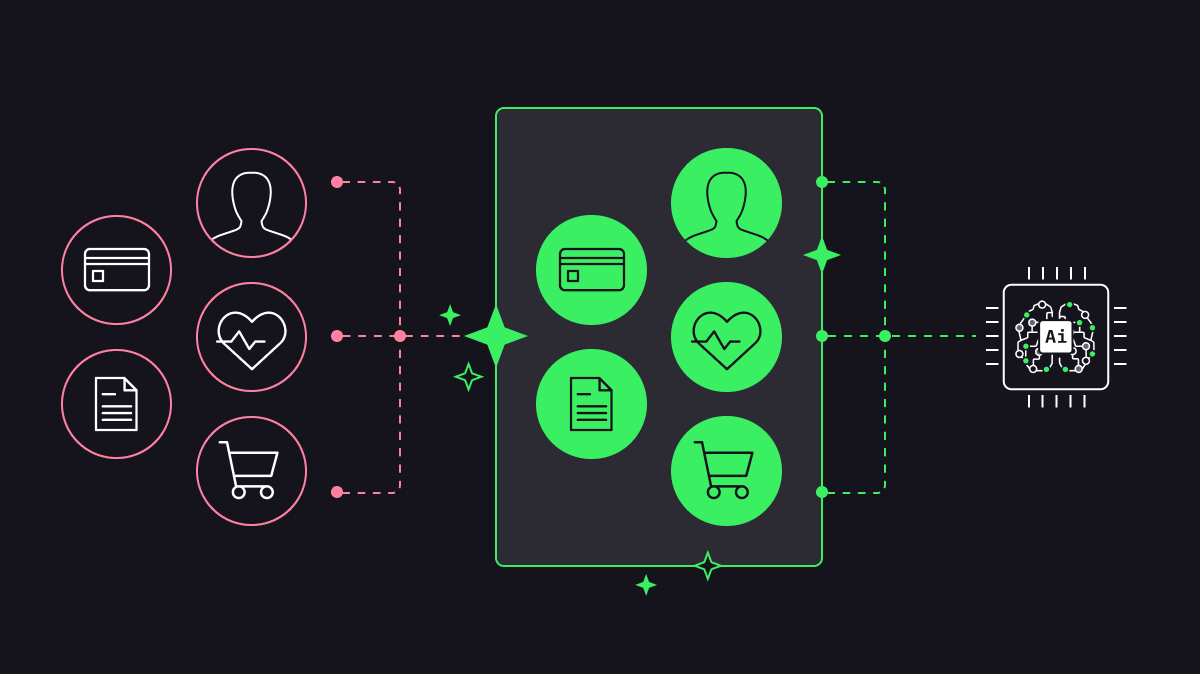
Training an AI model on real customer or patient data means that data exists somewhere in the training pipeline, in logs, in intermediate storage, in the hands of whoever has access to the training environment. In a fraud detection model, that means real account numbers and transaction details. In a healthcare model, it means real patient records. Sharing that data with a third-party training partner multiplies the exposure.
This is what synthetic data is built to solve. It replicates the statistical structure and behavioral patterns of real data closely enough to be useful, without containing any actual individual's information. Get it right, and a model can train on data that behaves like production without carrying the same compliance risk.
The evidence is starting to back this up in practice:
- Banks piloting synthetic transaction data for AML testing have reported task-level equivalence with production datasets in the 96-99% range
- Fraud detection models trained and stress-tested against synthetic variants in UK regulatory sandbox programs have shown accuracy improvements of roughly 15%
- Financial services firms using synthetic data to work around regulatory data-access constraints report cutting model development time by 40-60%
Regulators aren't waiting for the technology to catch up
The rules here aren't waiting around. The EU AI Act's phased rollout is bringing major training-data governance obligations into force through 2026, requirements around data quality, bias testing, and provenance that apply regardless of whether the underlying data is real or synthetic. GDPR guidance has also hardened on a specific point: scraping publicly available data doesn't automatically give you a legitimate basis for training, and personal data processed by AI systems still requires a documented impact assessment.
Similar momentum is building stateside. Under California's AB 2013, generative AI developers now have to publish summaries disclosing whether their training data includes personal information or synthetic data. Colorado's AI Act, still moving through amendment cycles as of this writing, is set to require risk management programs and impact assessments wherever high-risk AI touches lending or employment, once in force. None of this is sitting at the guidance stage. Fines have already been issued over GDPR violations in how training data was handled.
None of this makes synthetic data automatically compliant. Teams operating under these frameworks need to verify that their synthetic data pipelines actually meet the current regulatory definitions of anonymized or non-personal data, since generating synthetic data doesn't automatically satisfy that bar on its own.
Where synthetic data works well, and where it doesn't
The honest answer is that synthetic data is not a universal substitute for real data, and treating it as one creates its own risks.
It works well when the goal is coverage of scenarios that rarely occur naturally, the edge cases and rare conditions that real datasets simply don't contain in sufficient volume. It also works well when sharing real data with a third party or offshore team isn't an option at all, since synthetic data removes that constraint entirely.
It works less well when legal traceability to real events is required. In some regulated contexts, audit trails need to trace back to actual transactions or patient records, and synthetic data has no such provenance. It also carries a genuine technical risk if used carelessly: training AI systems on data generated by other AI models, without validation against real benchmarks, can lead to model quality degrading over time rather than improving.
Getting real value from synthetic data means validating it properly, not assuming it works. Most teams hold back a small, secure set of real data specifically to confirm that a model trained on the synthetic version performs on par with one trained on the real thing.
Synthetic data is strongest at scaling and protecting what the real data already shows a model, and weakest at teaching a model something the real world hasn't shown yet. The realistic use of synthetic data in AI training isn't as a wholesale replacement for real data, but as a governed component in the pipeline: synthetic for scale, privacy, and class balance, real data, properly validated, at the points that matter most, model finish lines and genuinely novel patterns.
Where AI teams in regulated industries should actually start
Replacing real data everywhere isn't the goal, and treating it as one usually backfires. A better approach is to find where real data creates the most compliance exposure, or where it can't cover the scenarios needed for testing, and build a validated, auditable synthetic pipeline for those cases first.
That requires more than a generic data generation tool. It requires a platform that understands the statistical distributions and relationships within the source data well enough to preserve them, applies privacy protections by design rather than as an afterthought, and produces an audit trail that can stand up to the regulatory scrutiny this space is clearly moving toward.
A practical starting point looks like this: generate a synthetic training set from whatever real data you're already permitted to use, hold back a small real-data sample nobody touches during training, and validate the model against that holdout before drawing any conclusions. This gives a concrete, low-risk answer to the two questions that actually matter before scaling further.
Want to see what production-realistic, privacy-safe synthetic data generation looks like in practice? Book a demo and find out how Synthesized helps regulated organizations build the training data foundation their AI initiatives need.