
Recently, we hosted a webinar with SAP advisor and community influencer Paul Kurchina and our Head of Product, Eesha Gholap, on the test data question most SAP Autonomous Enterprise conversations skip over. Here are the key takeaways.
The context
At SAP Sapphire 2026, the conversation was dominated by AI and agents. What received considerably less attention was the foundation on which those agents depend. The test data side of the Autonomous Enterprise conversation is almost entirely absent from most programs' planning, and that gap is where transformations quietly run into trouble.
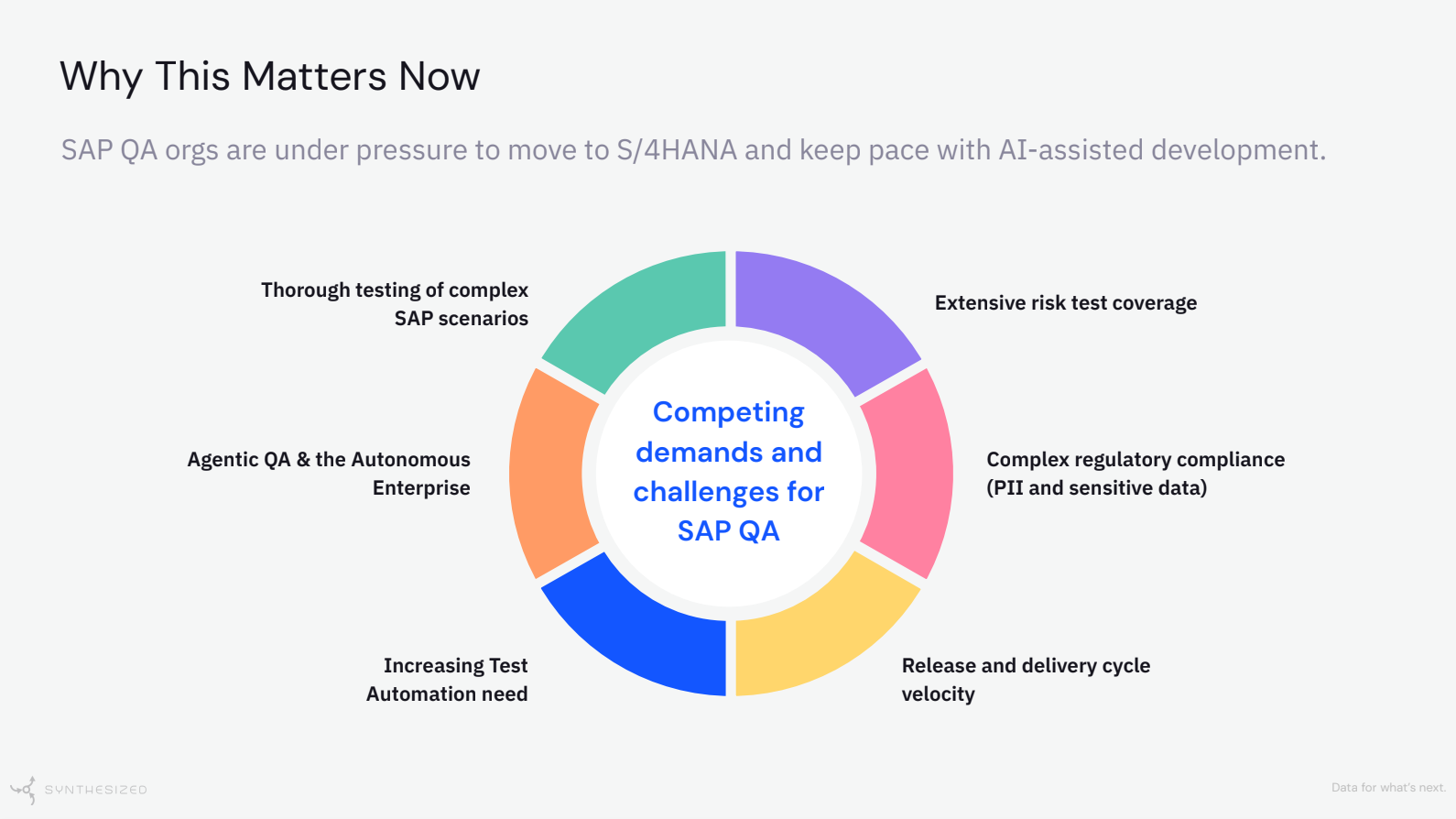
SAP QA teams are managing more competing demands than ever before, all arriving at once: -
- Risk coverage
- Regulatory compliance
- Release velocity
- Growing automation requirements
- Agentic QA.
Every one of those pressures traces back to the same dependency: the right test data, at the right time, in the right shape.
The wheel below captures it well. Six distinct pressures, all competing for the same people and the same windows. What sits at the center of all of them is test data.
Why traditional approaches are reaching their limits
Most SAP test data processes were accumulated rather than designed. The result is four compounding problems:
- Manual effort: Custom ABAP scripts and tribal knowledge held by a small number of specialists. When those people leave, the knowledge goes with them.
- Stale data: Annual refresh cycles mean nine months of testing against data that no longer reflects current conditions, and for agentic systems, stale data trains agents toward incorrect behavioral patterns before go-live.
- Coverage gaps: Production data reflects what occurred, not what the system needs to handle. Edge cases and rare configuration states have to be deliberately built.
- Scale: Full SAP copies run into terabytes, while client copies can take hours to days. Maintaining multiple environments is a standing cost that the program consistently absorbs.
Where most programs actually are
With the 2027 ECC maintenance deadline concentrating minds, the conversation at Sapphire might suggest most organizations are well into AI-driven testing.
The reality is considerably more grounded. The vast majority are still working through migration, and the pressures at each stage, while different in character, all trace back to the same root cause.
The three-stage map below shows where those pressures show up differently depending on where a program sits: migration, stabilization, or early autonomous enterprise adoption.
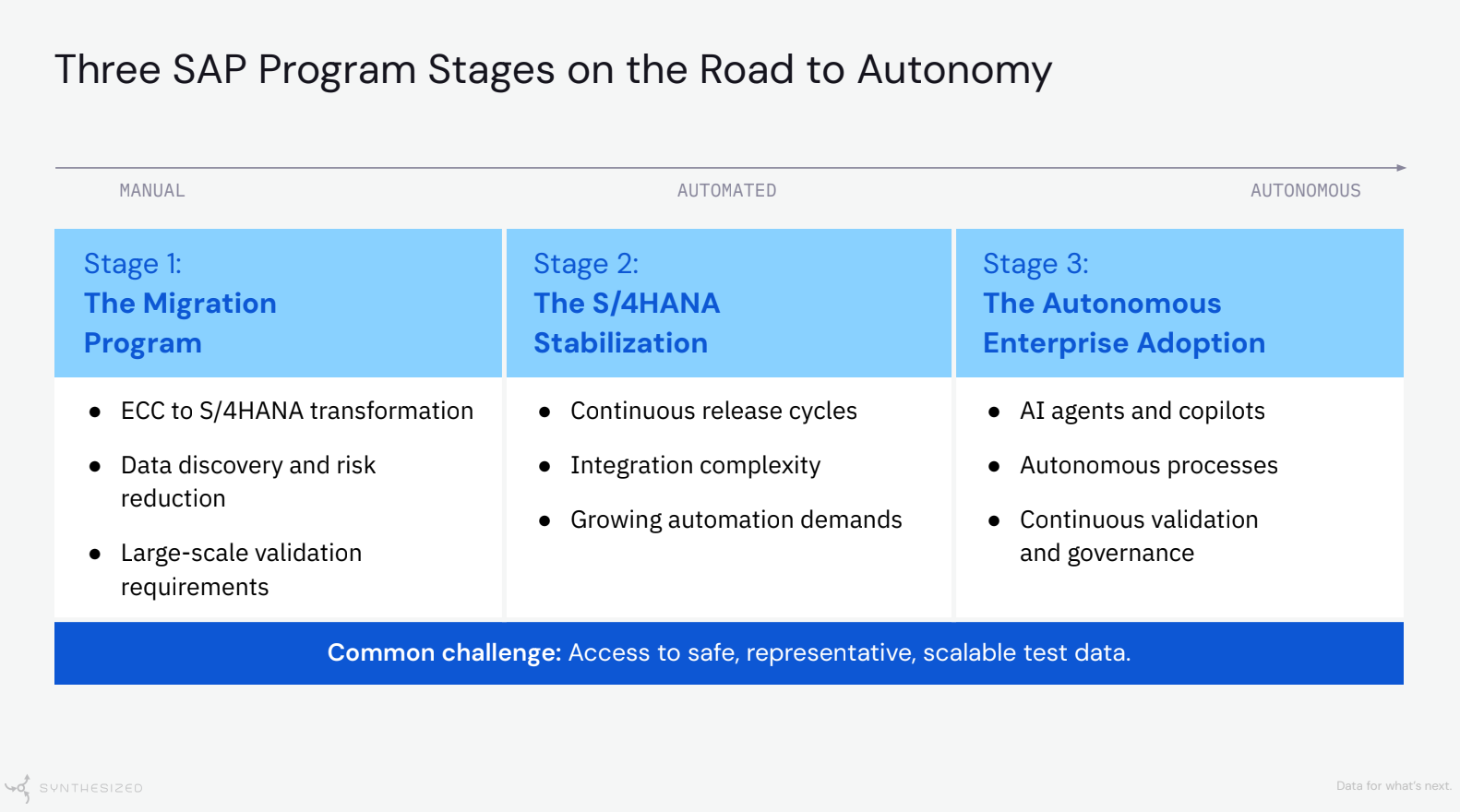
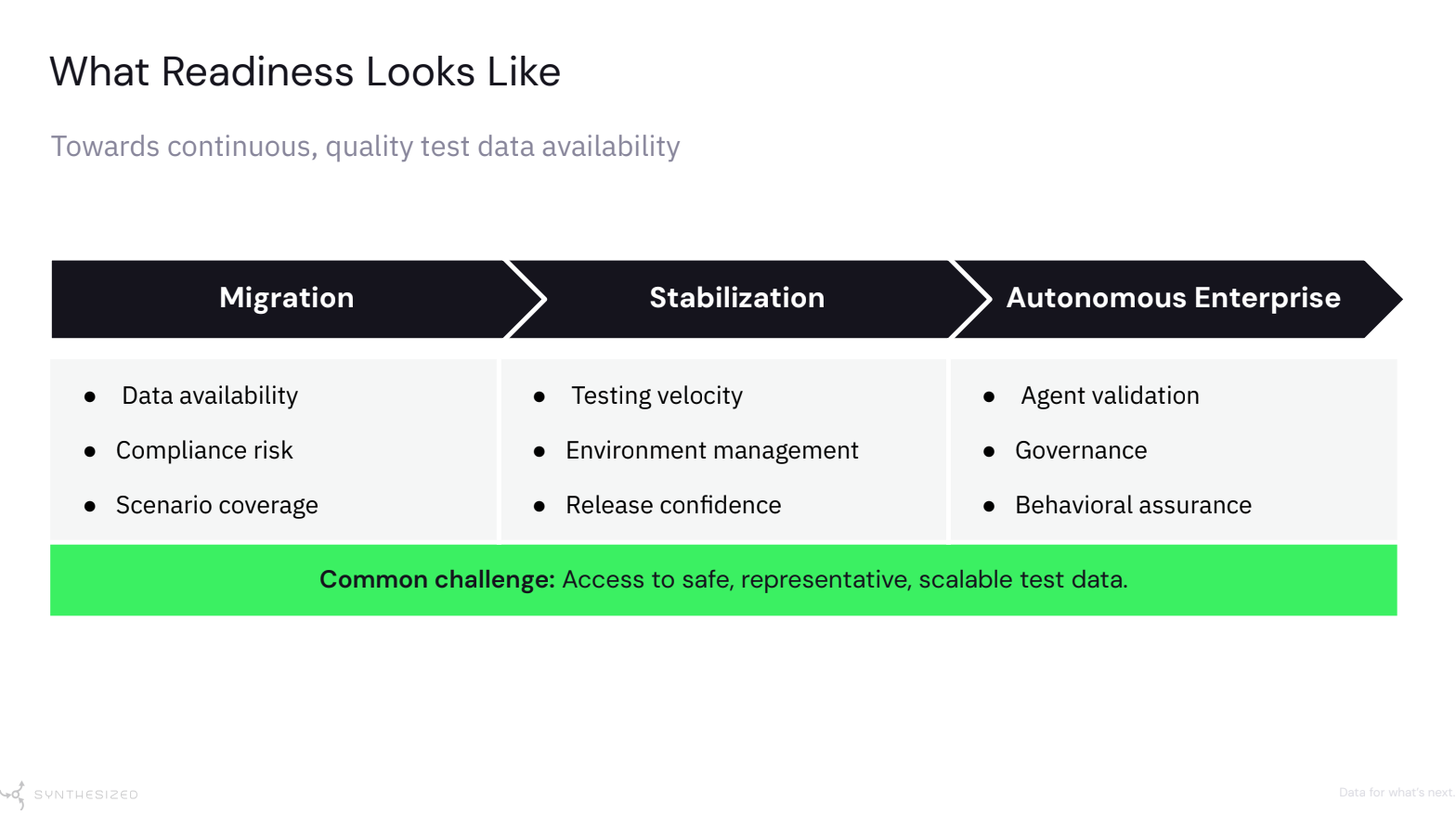
What the map makes clear is that access to safe, representative, scalable test data is the common challenge regardless of where a program sits. The bottleneck does not change as programs mature. It just gets more expensive to ignore.
What changes when agents enter the loop
A human tester can work around a data gap. An agent running continuously cannot. Agentic QA requires data that is always available on demand, representative of complete business processes, synthetically enhanced to cover edge cases that production data does not contain, and privacy-safe by default.
The session introduced a useful distinction: the difference between inefficient and fundamentally unfit. Inefficient means it works, but slowly. Unfit means it doesn't meet the dimensions agents require. Three quick tests:
- Can it deliver data via API without human intervention?
- Is it fresh at agent cadence?
- Does it cover the rare conditions where agents are most likely to fail?
The readiness slide below maps what solving it looks like at each stage: data availability and compliance risk in migration, testing velocity and release confidence in stabilization, and agent validation and behavioral assurance in the Autonomous Enterprise.
The test data control plane
This concept generated the most discussion. Rather than patching each gap as it appears, a control plane defines governance once and applies it consistently.
It manages reusable, versioned test data assets for core processes like Order-to-Cash and Procure-to-Pay, and enables self-service access for both human testers and agentic workflows. The same foundation scales through migration, stabilization, and autonomous enterprise without being rebuilt at each stage.
What the audience told us
The session poll produced a telling result. Repairing and maintaining test data ranked as the top pain point, ahead of access issues and coverage gaps. Most SAP programs have enough data. The challenge is keeping it usable, up to date, and compliant as the program evolves.
Want to go deeper?
The session covered a lot of ground in under an hour. The Test Data Imperative, our whitepaper on fueling the journey toward SAP Autonomous Enterprise, covers all of it in considerably more detail. If the session raised questions you want answered properly, that is where to go next.
Missed the live session? Access the recording.