Ask any engineering leader who has been through an S/4HANA migration why it took longer than planned, and you'll hear a lot of answers. Resourcing. Scope creep. Integration complexity. What you hear less often, but what comes up repeatedly when you dig into the details, is the lack of availability of good test data.
Not because it's an obscure problem. Because it's an unglamorous one. Test data is a critical element of quality assurance, but its quality and availability often get overlooked. It gets treated as something the QA team will sort out until the QA team can't, and suddenly, three weeks of the delivery schedule have disappeared into test environment preparation and semi-manual test data operations.
SAP makes this problem significantly harder than it is in most other enterprise applications and ERP (Enterprise Resource Planning) systems. Here's why.
Why SAP’s Data Model Breaks Traditional TDM Tools
A typical SAP environment isn't a single system with a clean schema. At its core sits the ERP platform, S/4HANA or ECC, where finance, procurement, sales, logistics, and HR all run in one tightly connected system, sharing the same data. Around it sit additional products like Ariba, SuccessFactors, and BW, alongside external platforms that feed data in and out. And underpinning all of it are the separate environments every enterprise runs: development, QA, and production, each holding large, highly structured datasets that have been built up and customized over the years.
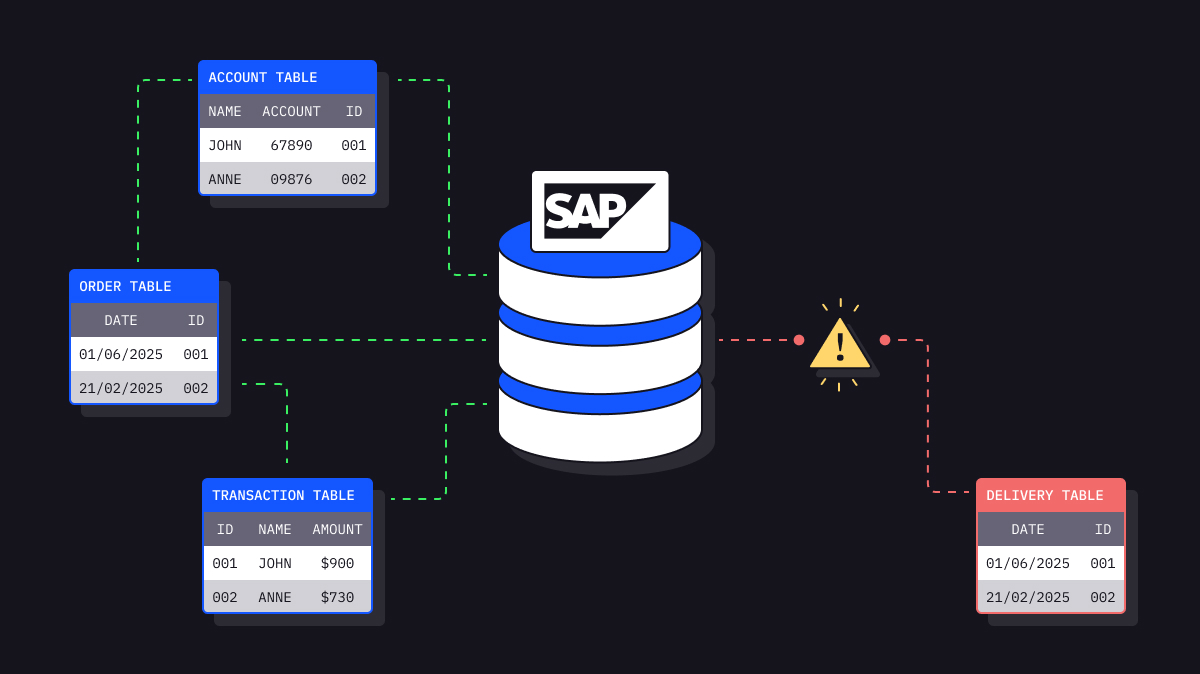
SAP runs on thousands of interconnected tables and configuration objects, and they do much more than store data. Embedded inside them are your business rules, organizational hierarchies, and process logic, built up over years, specific to how your organization actually works. Z-tables, custom ABAP, client-specific settings: it's all tightly coupled in ways that most generic TDM tools have never had to account for. Those tools were designed for simpler relational databases with predictable structures. Apply them to SAP, and you get test data that looks reasonable until it meets real process logic, at which point it falls apart.
How Broken SAP Data Relationships Derail End-to-End Testing
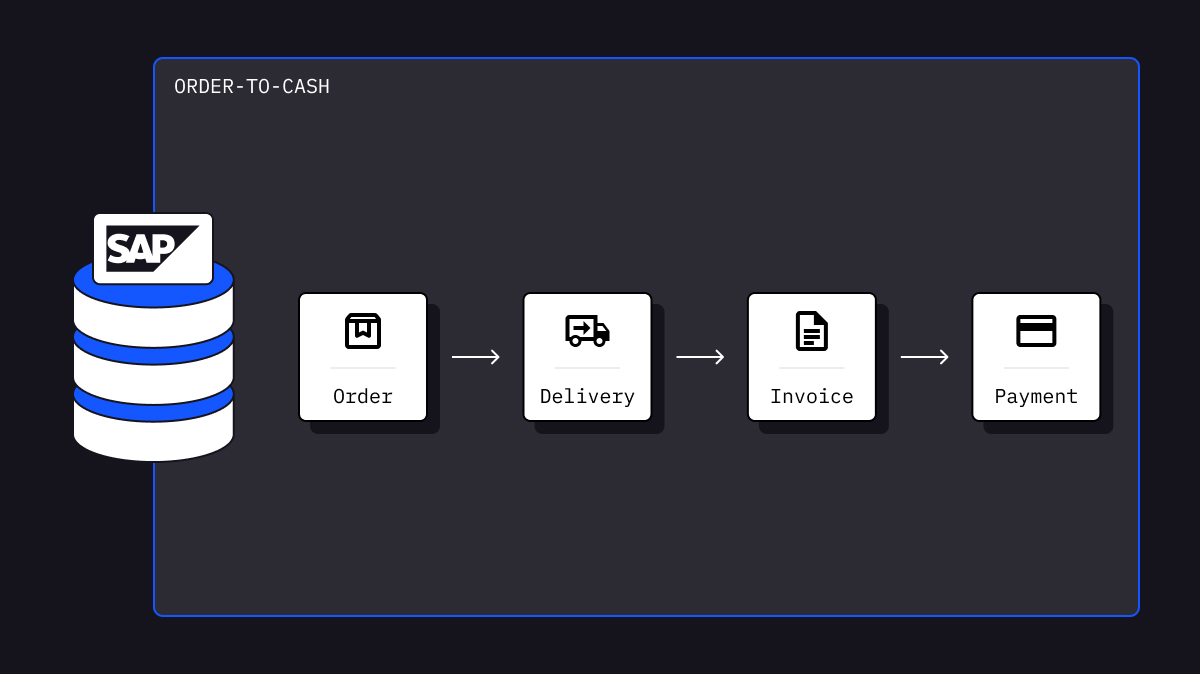
Order-to-Cash, Procure-to-Pay, Record-to-Report; each step depends on the integrity of the last. Break one, and the rest quietly drift out of sync. A purchase order links to a goods receipt, which links to a vendor invoice, which links to a payment run and the associated accounting entries. Pull one thread and the whole thing unravels.
This is what happens when test data is subsetted or copied without preserving those relationships. Tests pass in the early stages. Then they fail further down the chain, in ways that are slow to diagnose and hard to trace back to a data issue. QA teams log defects. Delivery teams investigate. Eventually, someone realizes the test data was never coherent to begin with.
For engineers, the alternative, hand-maintaining keys, dependencies, and sequences across company codes, plants, and organizational units, doesn't scale either. There's no good manual answer to this problem.
Why Copying SAP Production Data Is No Longer Safe Or Compliant
For a long time, the approach was straightforward: production data is realistic, so copy it, mask the obviously sensitive fields, and give it to the test team. It was once widespread and considered an acceptable practice.
That's no longer the case.
Over the past decade, data protection has shifted from a largely European concern to a global norm. Most countries now operate some form of comprehensive privacy law, and the expectations these frameworks set are around data minimization, purpose limitation, and security, which apply regardless of where an organization is headquartered or where its data sits.
SAP holds employee records, payroll data, customer and vendor information, and detailed financial transactions, all of it personal data that carries legal obligations wherever it sits. When that data is copied into test environments, it becomes accessible to more people, more systems, and more integrations, often with weaker access controls than in production. Manual masking across SAP's many modules is inherently inconsistent. The gaps it leaves aren't always visible to the teams doing the work, but they're exactly what auditors look for.
DLA Piper's 2025 GDPR survey puts cumulative fines since 2018 at €5.88 billion, with enforcement now firmly established across financial services, energy, and healthcare. GDPR, SOX, and HIPAA exposure from poorly managed test environments is a real and growing risk, not a theoretical one.

Slow SAP Client Copies And Refreshes Kill Testing Velocity
Even organizations that have got compliance broadly under control still struggle with speed.
Creating or refreshing an SAP test environment typically involves full or partial database copies, custom subsetting and masking scripts, and manual intervention whenever a relationship breaks or the configuration has drifted since the last refresh. SAP's own documentation notes that a client copy can take several hours or even days, depending on data volume. Across development, QA, performance testing, and UAT environments, that time compounds quickly.
Program managers feel it as pressure on the schedule. Technical teams feel it differently: datasets go stale fast, and as configuration evolves, the tests built on top of them quietly lose coverage without anyone necessarily noticing until a defect gets through.
Where Cross-System SAP Integration Testing Falls Apart
SAP rarely operates alone. Most enterprise journeys run across SAP and adjacent systems: Ariba handling procurement, Salesforce managing customer interactions, specialist warehouse or banking platforms sitting alongside core ERP. The business wants to know if the whole process works. That means tests need consistent, aligned data across all of it.
In practice, each system's test data is usually prepared by a different team, using different tools, at different times. The IDs don't match. The dates are out of sequence. The financial values don't reconcile. Integration tests break in ways that take disproportionate time to debug, and the root cause is almost always data misalignment rather than a genuine application defect.
Existing legacy, SAP-only TDM tools have nothing to say about this problem. They stop at the SAP boundary and leave teams to figure out the rest, which usually means more manual work and more fragmented processes.
The Real Business Cost Of Poor SAP Test Data Management
S/4HANA migrations overrun. Regression cycles are cut short because there isn't time to properly refresh the data. Developers and testers spend hours on data wrangling that adds no direct value to test coverage. Business stakeholders conclude that SAP testing is inherently slow and expensive, when the actual constraint isn't testing — it's the data.
These aren't isolated cases. There are consistent patterns across enterprises running complex SAP environments without a purpose-built approach to test data management.
What Modern SAP Test Data Automation Looks Like With Synthesized
The organisations that have moved past these problems tend to have one thing in common: they've stopped treating test data as a manual, project-by-project concern and started treating it as something that needs to be automated, governed, and continuously available.
That means on-demand provisioning of production-realistic data that preserves SAP's business logic and relational integrity across modules. It means PII detection and masking are handled automatically, not by hand. It means test data that spans SAP and non-SAP systems, so integration testing doesn't require a separate manual effort every time. And it means all of this being available within minutes, not weeks, so continuous testing stays continuous.
Synthesized's AI-native SAP test data management platform is built around exactly this model. Deep schema intelligence, automated compliance, and production-realistic data generation combine to give SAP engineering teams reliable, ready-to-use test data for every environment, every cycle, and every pipeline — without the manual overhead that has historically made SAP testing so costly to sustain.
Ready to see it in action? Book a demo and find out how Synthesized helps SAP engineering teams move faster, test smarter, and go live with confidence.