
Still pulling data subsets from production by hand? Still running masking scripts that someone wrote two years ago and nobody's touched since? Still spending the first three days or more of every test cycle waiting for environments that should have been ready yesterday?
If any of that sounds familiar, you're in good company. Manual test data management (TDM) is still the default across most enterprise engineering teams, not because it's the right approach, but because it was already there when everything else was built around it. It works. Until the moment it doesn't. By then the cost has been quietly accumulating for a long time.
The hidden cost of manual test data management
Manual TDM is expensive in ways that are genuinely hard to quantify, which is precisely why it persists. There are two costs most teams never add up:
The time cost. Someone pulls the data, subsets it, masks it, validates the relationships, fixes the ones that broke, and provisions it into the right environment. Then the configuration changes, and they do it again. Then a new test cycle starts, and the previous dataset is three weeks stale, and they do it again. Distributed across a team, across multiple environments, across a full year, that time adds up to a number most engineering leaders have never calculated because it's absorbed into everyone's workload rather than tracked anywhere.
The delivery velocity cost. Manual testing already consumes around 30% of overall development effort, and a meaningful portion of that isn't the testing itself; it's waiting. Waiting for data. Waiting for environments. Waiting for someone to finish the manual process that's blocking the next pipeline run. In teams that have moved to CI/CD, where the whole model depends on continuous, automated flow, manual test data preparation is a structural mismatch. Everything else moves fast. The data layer doesn't.
The compliance risk lurking in your test environments
This is where manual TDM stops being an inconvenience and starts being a liability.
Manual masking is inconsistent by nature. Fields get identified, rules get written, and exceptions get noted somewhere. Then the schema evolves. A new table gets added. A contractor joins the project. Nobody updates the masking rules because nobody knows they need to. The environment that's supposed to contain only anonymized data still has records that shouldn't be there, and the only people who don't know are the ones who built the process.
Only 7% of companies report being fully compliant with data privacy regulations within their software testing environments. That figure is worth sitting with. Not 7% of small businesses without dedicated security teams. 7% across the board. In Europe alone, DLA Piper's 2025 GDPR survey puts cumulative enforcement fines since 2018 at €5.88 billion, with regulators now firmly established across financial services, healthcare, and energy, not just big tech. The exposure from poorly masked test environments isn't theoretical. It's the kind of gap that looks manageable until an auditor asks the right question.
How stale test data creates coverage gaps and missed defects
There's a third cost that's easier to miss until it causes a production incident: coverage.
Manual test datasets reflect a moment in time. The longer an environment runs on a static copy, the further it drifts from current production conditions. New configurations, updated business rules, and recent transaction patterns do not appear in data refreshed last month. Tests pass for the wrong reasons, and defects that only surface under current conditions go undetected.
There's a deeper problem underneath that, too. Depending on your application, a production subset might cover 80% of your test scenarios, or it might cover 20%. Either way, it's not good enough. You shouldn't be designing your tests around the data that happens to be available. You should be able to get the data you need for every scenario, on demand, without it being a project in itself.
What automated test data management actually delivers
Agile teams that have moved away from manual TDM tend to describe the shift in similar terms. It isn't just faster and more effective; it changes what's actually possible.
Ideal modern test processes look something like this:
- Environments that took days to provision take minutes.
- Masking is applied consistently at the point of data creation, not as a manual step that can be skipped.
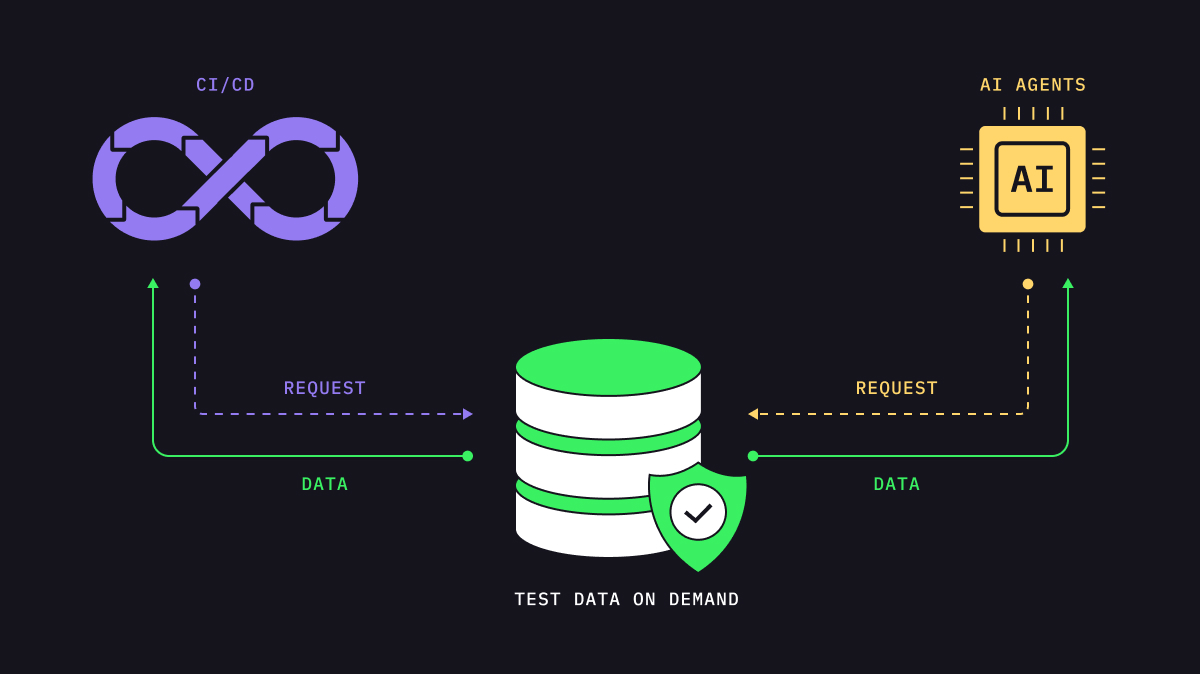
- Datasets stay current because they're generated on demand rather than maintained by hand.
- Edge cases and specific scenarios can be built precisely.
- Because the whole process integrates directly into CI/CD pipelines, the data layer finally moves at the same speed as everything else.
Organizations using automated provisioning and synthetic data report average reductions in testing cycles of 21% before accounting for the compliance overhead that manual masking adds or the developer time lost waiting for environments.
If the gap between where your team is and where it could be feels uncomfortably wide, it's worth asking what's actually holding back the change. For most teams, the honest answer is inertia rather than a technical barrier. The manual process is familiar. Replacing it requires a decision.
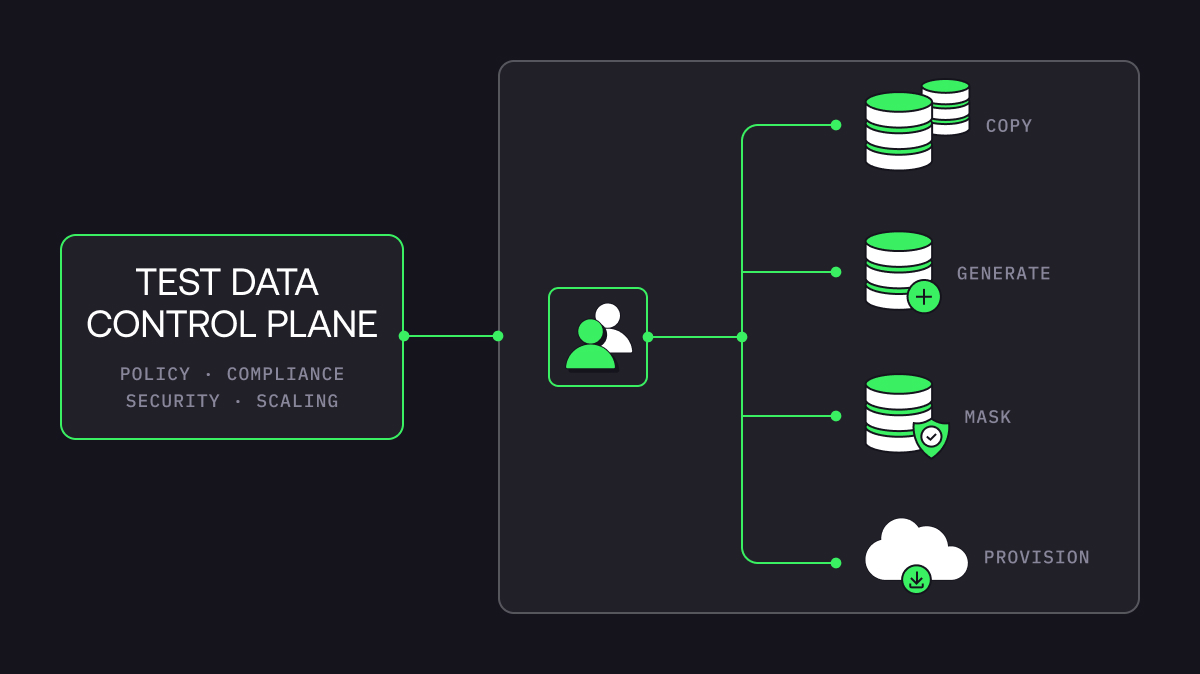
Synthesized's AI-native test data management platform is built to make that decision straightforward. Automated sensitive data discovery, intelligent masking, and on-demand provisioning of production-realistic datasets remove the manual bottleneck entirely, giving engineering and QA teams the data they need when they need it, without compliance exposure or delays. Organizations using Synthesized report delivery cycles running up to 70% faster and storage savings of up to 99% compared to copy-based approaches.
Manual TDM feels manageable right up until you add up what it's actually costing. Most teams that do the calculation modernize their test processes and don't go back.
Curious what automated test data management looks like in practice? Book a demo and find out how Synthesized helps engineering teams move faster, test smarter, and stay compliant without the manual overhead.